Sunday, January 25, 2015

Winter Storm--NOT!


Winter storm Juno turned out to be a big nothing. We were not disappointed. Terry in particular enjoyed his visit from the Goddess of Unexpected Free Time—the wicked north wind blew the little bit of snow we got clean off the driveway. No shoveling for him today!

The snow this morning didn't even cover the grass. The white parts are from before.
We had watched the storm anxiously as Hilda and I were scheduled to go to Crystal Lake this morning for the Land Conservancy’s brunch/fundraiser/annual meeting. In addition, Doug Elliott was going to tell us stories of groundhogs. Given that we had barely a dusting of snow, we were surprised that there was some drifted snow over the road as we went south, where more snow had obviously fallen. We made it to the event in good time nevertheless.

The brunch was a buffet. I had every intention of not eating too much, which is no different than every other buffet I’ve ever been to in my life. I was pretty okay until I got to the Eggs Benedict. I can’t pass up Eggs Benedict. And just one sausage, one piece of bacon, one chicken wing….. I ate too much, like every other buffet I’ve ever been to in my life.

When Hilda first told me about the event, I didn’t connect the groundhog topic to anything in particular. Once Elliott started talking, it was obvious that the topic was timely—Groundhog’s Day, duh. The alternate name “woodchuck” is a corruption of the Algonquin name for the animal. Nothing at all to do with chucking wood. “Raccoon” is also derived from Algonquin, and the Algonquin name literally translates to “one who wanders by the shore.”

So what about Groundhog’s Day? February 2 is halfway between the winter solstice and the spring equinox. It was a sacred day for Pagans. Elliott explained the origin of the word “pagan” as “country folk” from ancient Roman times, as great cities developed around “monotheistic desert religions” the worshiped one God in the sky, and those still on the farm continued with their earth-based religions that centered on the seasons.

Elliott also explained that counterintuitive thing about the groundhog’s shadow. Early people were keen observers of nature. Bears and groundhogs had particular significance for them as intermediaries between Grandfather Sky and Grandmother Earth. Both of them disappeared into the earth in the fall and were presumed dead, but were reborn in the spring. The shadow is our darker self, which is only separated from us by death, the final and most peaceful sleep. If the groundhog comes out of hibernation and sees his shadow, it means that he has not completed his death cycle, and he is not yet ready to be reborn. So he goes back to sleep. Or something.

For people, February 2 was when you looked at what you had left, and hoped it was at least half of what you put by for the winter. We’re going to make it. I’d say we’re about halfway through the potatoes, although they’re starting to sprout, which means we will be in the Month of the Wrinkled Potatoes before long. We really, really overshot on the onions. I bet we haven’t eaten even a quarter of those. I had to clean out a rotten one and a sprouted one recently. I’ve seen more taking on that characteristic gotta-sprout-soon elongated form. Garlic? No shortage, and likely to start sprouting soon also.

And the freezers! I’ve been working on reducing the inventory. We’ve had so many suppers of Tundra Surprise lately that I can’t remember the last time I started a meal with raw meat. Stuffed peppers from September, baked tomato pasta sauce from August, stuffed cabbage from July, pot roast in wine sauce from October, chicken in stock from December, roast pork in gravy from the late Cretaceous, all served with a side of Brussels sprouts, corn, green beans, beets, cabbage, sauerkraut, or squash.

Sometimes it feels like work trying to get through all this food. And yet, it is a good problem to have. I try to remember to admire my plate when I sit down to eat and say to myself, “I grew these potatoes; I fed this chicken; I cleaned and blanched and froze these Brussels sprouts.” It makes me quietly proud.

Sunday, January 18, 2015

January Thaw


I have mentioned many times that one of the things I most enjoy about chickens is their ability to greet every moment as the best thing that has ever happened. I made a little video of the greeting we receive when we have snow on our boots. Snow! That is the best thing ever! It’s cute in the video also because you can see little Gracie (the black and white one with the wild head feathers) at the periphery having a sense that something exciting is happening, but not really being able to figure out what it is.

We’ve had a lovely warm weekend here with temperatures above 40° during the day and above freezing at night. The amount of snow on the ground is greatly reduced. Hilda and I took the opportunity to replace all the wood chips in the coop. I’m not sure the girls appreciated it, but we sure did.

The girls and the fresh wood chips
Gracie (Silver Crested) and Fiona (Welsummer)
 
We’ve had some trouble with one or more of the girls pecking at the eggs. Most of the time, the shell is broken but the membrane is intact. On a couple of occasions, however, an egg has been eaten. This is distressing because most things I’ve read suggest that once a chicken gets the idea that eggs are good to eat, egg eating can spread to the flock, and you can kiss your over-easy breakfasts goodbye. The best solution seemed to be using nest boxes that allowed the eggs to roll out into a collection tray that was inaccessible to the hens. Such a design had the added benefit of cleaner eggs because the hens didn’t have a chance to walk over the eggs with their muddy/poopy feet.

Hilda looked in the catalogs for roll-away nest boxes that were expensive and would involve major reconfiguration in the coop. I did some research in the DIY world and found plans for an easy-to-install ramp. The design seemed obvious to me, but it was less obvious to Hilda and Terry. In the end, however, both of them got it. A particular sticking point for Terry was the idea that the ramp needed to extend more than 4” past the nest boxes. I explained that the eggs had to roll beyond the reach of the chickens. Once he went into the coop to start measuring, he finally understood the point. The hens gave him their typical welcome of pecks everywhere. Terry was amazed at the range of motion of their head and neck. “I can see why you wanted more room on the outside,” he told me.  

During the week, Terry cut wedges to prop the ramp up and put two slits in a piece of plywood to make room for the walls between the nest boxes. With the weather so nice yesterday, Terry set about putting the ramp in. He began by gluing indoor-outdoor carpet onto the plywood. I wasn’t sure how well it would hold up in the coop. This batch of chickens seems to peck everything apart. There was also the open question of their use of the newly configured nest boxes.

First eggs in the roll-out tray
When I got home from shopping yesterday, Terry was eager for me to see his handiwork. He’d only finished the installation 45 minutes earlier. We walked out to the coop, and there were already 3 eggs in the egg collection area.

And this morning, there was still carpet in the nest boxes. I didn’t see any sign of pecking at all.

Inside the nest box on the second day
The only thing we’re still working on is the length of the rubber curtain. It’s a little stiff and does not always allow the eggs to roll through. We are shortening the fringe little by little until we get to the point where the eggs will always escape the nest box.

Sunday, January 4, 2015

Winter is upon us


Winter is upon us. Yesterday was warm but dreary, with rain and snow alternating all day long. In the afternoon, I looked out at the fifth oak and saw a bird that was a little larger than a dove. With binoculars, I could make out an orange tail and orange shoulders. It seemed quite miserable with its tail feathers spread out as if trying to dry them. I thought I saw a vertical black strip on its head when it turned. I looked through Sibley and was able to identify it as an adult male American kestrel. Cool! I haven’t seen one of those in several years. He was a shy little guy. I wasn’t able to get very close with my camera, and this is the best picture I could get before he flew off.
Kestrel drying its tail. You can kind of see the orange shoulders and the black tipped orange feathers of the tail.

Today has been just like winter. The temperature was 29° when I got up at 6:15. It has dropped steadily ever since with a wicked northwest wind blowing snow. Hilda opened the coop door this morning, and no one wanted to go out. There weren’t even any hens by the door. She closed the coop again.

I will be easing back into work this week. Classes don’t start for two more weeks, but I have meetings already on Tuesday. I figured I might as well get back in the routine. I made five servings of carrot and celery sticks and peeled five grapefruits for my lunches. Even though it looked cold and nasty out, I have been trying to walk outside more often in my increasingly elusive quest for a good night’s sleep. As long as I had to bundle up to take the kitchen scraps to the mulch bin and the carrot peelings to the girls, I decided to walk at least a little.

I put the carrot peelings on the ground and opened the coop door again. A couple of girls stuck their heads out, but no one ventured forth. I left the door open while I went for my walk. I had overdressed and was sweating by the time I got to the southwest corner. It really wasn’t such a bad day to be outside. There was more snow on the ground than I realized. The creek was so pretty that I went back to the house for my camera and walked to the creek again to take a picture.

The creek, frozen over, in the snow

All of the carrot peels were still on the ground when I went to the coop again. I shut the door and let the girls be. They really don’t like the wind. I checked for eggs and found three. All of the next boxes were occupied, maybe because they were the warmest places in the coop.
Carrot scraps untouched outside the coop door


Left to right: Nadia, Cleopatra, and Lizette in the nest boxes
Our cat Della is 20 years old now. She’s holding up fairly well. She sleeps a lot. We have a futon that is pretty much all hers. When she wants us to pet her head, she stands at the end and cries. The video does not capture her best singing. She likes to sleep under a blanket in what we call the “cat cave.” Some years ago when she started getting feeble, Terry made a handicapped ramp for her. He then patiently trained her to use it by dragging a string up and down the ramp while she chased it. Eventually, she learned to use it on her own. Lately, she has taken to walking down the ramp with her front legs while sliding on her back legs. It’s pretty hilarious.
 

Thursday, January 1, 2015

Happy New Year!

One more thing that tells me I’m getting old: staying up until midnight on New Year’s Eve just seems stupid. Admittedly, my threshold has been moving up over the years. When I was young, it had to be midnight local time. When we moved from Buffalo to Illinois, we continued to celebrate the New Year on New York time. This year, London’s New Year was just fine with me.
I made the traditional caramel pecan rolls for breakfast today. Terry and I went upstairs to enjoy them with Mom and Dad.
The first breakfast of the New Year ought to be a good one!

While I was having my second cup of coffee, I saw a huge bird fly over the field. What was it? Great blue herons are all in Florida this time of year. As it banked, I saw a white tail. Could it be? I rushed from the breakfast table to grab the binoculars. Yup, black wings, white head and tail, bald eagle! Everyone got up to see it. It was hard to find in the binoculars, but as it turned the flashes of white before and aft were visible to the naked eye. I took this as a sign that wonderful things will come our way in 2015.

Monday, December 29, 2014

You better Belize it, Part 4

Wednesday, Dec. 17. It was another cloudless morning. When I did the site visit last January, I had wet feet every day I was there. It was such a relief to not have gotten my shoes wet once on this trip. We drove west to San Iganacio. We spent the morning touring Mayan ruins at Xunantunich and Cahal Pech. I hadn’t been to Xunantunich last year because the water was high. I hadn’t understood the problem at the time. I learned that there is a ferry across the Mopan River between the main road and the archeological site. Furthermore, the ferry is hand cranked!
Rapids on the Mopan River


Our guide explained Mayan architecture, daily life, rituals, religion, and other cultural practices. We climbed to the top of El Castillo, the royal residence, at Xunantunich, where we could see Guatemala. It was a lot of climbing, and the steps were high. Pablo explained that the large steps were intentional, as it forced the climbers to bow to the royalty seated at the top. Once I heard this, it was easy enough to verify.
Up

Up!

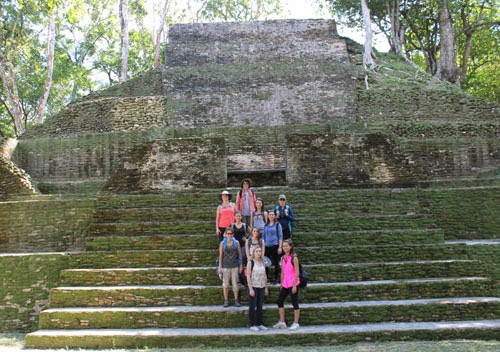
Sorority shot before climbing the rest of the way up El Castillo, the royal residence
Up!

Up!

The top, with Guatamala in the distance

View of Belize from the other side of the top of El Castillo

There is nothing to mark the boundary between Guatemala and Belize in this area. Border guards armed with machine guns were visible at the perimeter of the park.
Down

Down the other side of El Castillo

We had only been at Xunantunich a short time when busloads of tourists from cruise ships arrived. One of the students later referred to them as termites, an apt descriptor as they swarmed over the ruins.
It was a relief to get back in the van and go to Cahal Pech, where we had the place to ourselves. I was surprised, as Cahal Pech had been crowded last year. I inferred that Cahal Pech is the fallback for the cruise ship tourists when Xunantunich is inaccessible. Xunantunich has a larger “wow” factor because the royal residence is higher and has replicas of stone carvings on two sides. Cahal Pech is, however, the more historically significant because it was continuously occupied for 2 millenia from 1200 B.C.E. to the late 800’s C.E.
Temple with alter at Cahal Pech

Sorority shot in front of the Royal Throne at Plaza A

Loyal subjects bow before the queen
Passageway among royal bedrooms

We had a picnic lunch at Cahal Pech. The Lodge packed out burritos. I expected the burritos to be pre-made. Instead, we had individual containers including a stack of enormous, thick, home-made flour tortillas; sautéed chicken, peppers, and onions; salsa; refried beans; sour cream; bananas, other stuff I’m forgetting, and a whole watermelon that we did not cut. There was plenty of food without it.
After lunch, we went to the Green Iguana Conservation Project to learn about how the green iguana came to be endangered by selective hunting of females with eggs. The eggs, harvested from inside the female, have traditionally been used as an aphrodisiac. There is no scientific evidence to support that the eggs have any effect, but the practice continues. Captive breeding and education are working together to restore the population.
Orientation at the Green Iguana Conservation Project

Girls with iguanas

Girls with baby iguanas

We spent an hour shopping in San Ignacio, a tiny and rather seedy town. Several of the students explored a grocery to compare prices. Some food seemed about the same, some was much more expensive. I noticed that the eggs were stacked in open crates, 3 dozen eggs to a layer, on an unrefrigerated shelf. It was an interesting experience to walk down the street, sweating in the considerable late afternoon heat, while the sounds of Christmas carols in Spanish came through the open shop doors.
We had our last dinner at the lodge that night. I told the girls that I felt extremely fortunate to have spent the week in the company of such a remarkable group of women. Everyone was engaged and enthusiastic even when pushed outside their comfort zone. I had brought a notebook to discuss what should be changed in the course for next year. Nearly every suggestion was a change to the pack list. Everyone thought the online portion of the course was seamlessly integrated with the field activities, except that they wished they’d read more about the ethnic groups of Belize. There wasn’t anything they would change, even the order of the days. Score!
Dinner with the Christmas tree
Thursday, December 18. We left for the airport at 8:30. Everything went according to schedule all day. We managed to stay more or less together through Immigration and Customs in Miami, and get through it all in 1 hour and 40 minutes, leaving 80 minutes to get something to eat, which was important as we’d pretty much missed lunch. As soon as we got to the gate, the students were on their phones setting up a Facebook page where we could share our photos. I took this as one more piece of evidence that the trip had been an overwhelming success.

Saturday, December 27, 2014

You better Belize it, Part 3

Tuesday, Dec. 16. We drove an hour and a half north of the lodge to Bermuda Landing to visit the Community Baboon Sanctuary to learn about conservation of black howler monkeys and Kriol use of rainforest plants for housing, food, and medicines. There are no true baboons in Belize. The black howler monkeys were called baboons by slaves from Africa, where baboons are native. I can’t believe that they failed to notice the considerable physical differences between the new monkeys and the ones back home, but they were not taxonomists. Being dumped in a foreign land and forced to harvest mahogany trees was enough to deal with, I’m sure.
After using the restroom marked “Female,” we assembled in the corrugated iron shed that housed the Community Baboon Sanctuary interpretive center and museum. I noticed a camouflage net strung underneath the ceiling. I wondered at its purpose until I saw small insect-eating bats flying around between the net and the roof. Our noise must have disturbed them from their daytime sleep.

Bats hanging from the ceiling of the Community Baboon Sanctuary museum and interpretive center
A friendly cat circulated among the students and selected Kyra as his new BFF (best friend forever, for those not up on the lingo of the day).
Kyra with her new cat friend

Our guide introduced herself as Geraldine. She explained the history of the sanctuary, one of the first places on earth where private landowners signed agreements to use farming practices that were compatible with maintaining the population of howler monkeys. The provisions included leaving trees that were sources of food and shelter for the monkeys, not cutting the forest along the river’s edge,  and providing safe corridors for the monkeys to move from one forest fragment to another.
We had barely left the parking lot when Geraldine stopped us, walked to a fence line and pulled the leaf from a plant that resembled a yucca. She held the thorny tip with one hand while she pulled all the flesh from the rest of the leaf, leaving just the fibers. “This makes a needle and t’read,” she explained. “If you rip your pants in the jungle, you can use this to sew them up.”
Geraldine demonstrations jungle needle and thread
Across the road, she pointed out a vermillion flycatcher. Unfortunately, the photo of the bird in the shade failed to capture its remarkably red color.
Vermillion flycatcher
We hadn’t gone far into the jungle when Geraldine stopped in mid-sentence and looked up, noticing some movement or sound that the rest of us missed. “Here they are!” she said, leading us back up the trail. She imitated the howler’s roar, and sure enough, a troop of monkeys came right down the tree almost to arm’s length, and we heard the dominant male’s ear-splitting howl in the tree just above us. A recording of the call of the black howler monkey was used as the sound track for T. rex in Jurassic Park. I saw the same female baby I’d seen last year, judging by the birth date Geraldine shared with us. Her mother had a new infant, born this November.
Four monkeys (including an infant hanging on his mother)

Close up of mom and baby

We watched the howlers for quite a while. When they lost interest in us, Geraldine walked us farther down the trail to show us the national tree of Belize. She asked us to guess what it was, but the only one we could think of was the Ceiba, sacred to the Maya. But no, it is the mahogany, sacred to the Europeans, who began using slave crews to harvest the tree for profit in the mid-1600’s.
A mahogany tree
On our way back to the van, Geraldine showed us, among other plants, the red-flowered herb known as hot lips or womb plant. It is used to ease childbirth and help expel the placenta. Geraldine mentioned in passing that plants that look like a body part are often good for treating that part. The resemblance of the hot lips flower and the labia minora was obvious. And I had only associated the Doctrine of Signatures with Europeans.
Hot lips or womb plant
In the afternoon, our group split up for zip lining and cave tubing.
The zipliners

Liz on zipline

Even though these  where the only activities scheduled for fun rather than education, the students at the zip lines got to see and, if sufficiently brave, hold a red rump tarantula.

The cave tubers (makes them sound like potatoes…) saw fruit bats and learned that the acidic poop of the fruit bat dissolves the alkaline limestone of the caves so that large holes develop in the top of the cave where the bats roost.
The cave tubers
We had the fanciest towel art yet when we got back to the room. It was a bird nested in the pool towel.
Bird in next
On our way to dinner, Kate and I saw a tiny gecko on the outside wall above our door. Here is a photo with Kate’s hand as a size reference.
Tiny gecko with Kate's fingers
I had been thinking of having beef for supper, but when Gareth announced that the special was shrimp and lobster Creole, well…
Shrimp and lobster Creole with fried plantains, white rice, and steamed veg