![]() |
| Mr. Carrotface |
![]() |
| Potato harvest, upper left to lower right, Burbank Russet, Red Norland, Kennebec |
![]() |
| A champion-sized Kennebec |
![]() |
| Rolling up the weed barrier |
![]() |
| Banjo stretched from my feet to my hips--and not even full grown! |
![]() |
| My kitchen "helpers" |
A blog about country life dedicated to the patron saint of gardeners (and hemorrhoids)
![]() |
| Mr. Carrotface |
![]() |
| Potato harvest, upper left to lower right, Burbank Russet, Red Norland, Kennebec |
![]() |
| A champion-sized Kennebec |
![]() |
| Rolling up the weed barrier |
![]() |
| Banjo stretched from my feet to my hips--and not even full grown! |
![]() |
| My kitchen "helpers" |
I’ve been busy as a bee in a bucket of tar. Not only do we have grapes and apples up to the eyeballs, I had all sorts of meetings last week. I swore off picking tomatoes two weeks ago, but somehow cannot bear to let the last ones rot on the vine. I have become my mother.
Yet in the face of so many things on the To Do List, my
motivation is low. The days have been cold and gray with periods of rain. I am
grumpy. Fall is my least favorite season as Mother Earth packs up for her
winter nap. Every green thing is dying around me. The sun is out today, though,
and I have (as I always do) high hopes of having a productive day.
Not everything about fall is bad. There is, for example, raspberry pie! We shared this one with Kate and Jane, who came up last week to meet Banjo and Bingo.
![]() |
| Whole raspberry pie |
![]() |
| Sliced raspberry pie |
Speaking of, the kittens are still cute, although growing quickly. They are comfortable enough in their new home to appropriate my chair for naps.
![]() |
| Nap time in my chair. Note Bingo's leg over Banjo's back |
Last week, though, I was home so little that they started sleeping in Terry’s chair. That hurt my feelings a little.
![]() |
| Relocated to Terry's chair |
One evening as Terry was getting ready for his shower, he
dropped his work clothes on the floor. “You’ve got to see this,” he called to me
in the kitchen. “They look like they’ve killed an antelope.”
Sure enough, there they were, like lions on the Serengeti, guarding their prey.
![]() |
| Cats guarding a fresh kill (Terry's work clothes) |
Goldenrod and New England aster are the last gasps of summer blooms.
![]() |
| The last blooms of summer--New England Aster (left) and hard-leaved goldenrod (right) |
As such, they are popular with the pollinators. Included in
this picture are bumblebees, honeybees, and unidentified small flies. I waited all
summer for this particular plant to bloom. It started out with spectacular
large leaves. The stem grew and grew while the leaves decreased in size as the
height increased. My hopes for large, showy blossoms were dashed when numerous
small buds developed. At long last, about two weeks ago, the first blooms
opened, and it was another one of myriad goldenrod species, hard-leaved
goldenrod, Solidago rigida.
Pollinators on goldenrod
Like goldenrods, bumblebees come in lots of species. This one is twice the size of most bumblebees. I don’t know what kind it is. Bumblebee identification is above my pay grade.
![]() |
| Giant bumblebee |
Normally the New England aster is a deep purple, and most of ours is. I noticed these lighter shades for the first time this year. There are three different colors here: deep pink in the upper left, lavender in the middle, and light pink on the right.
![]() |
| Color variation in New England aster |
As we were eating supper last Friday, Terry spotted a deer among the river birch. At first he thought it was a buck because it looked so big. Binoculars settled the issue, as there were no antlers. The doe was already in her dark winter coat.
![]() |
| Doe in her winter coat |
Soon her fawns showed up, walking along the orchard fence, gazing wistfully at the apples within. They need not worry. We have so many that they will be getting their share when Terry dumps them in the back. He gets them away from the apple trees to break the breeding cycles of the pests.
![]() |
| Fawns by the orchard fence |
I took several pictures, trying to get all three in one frame. They finally posed for me. Like many family photos, however, one member of the group had her eyes closed.
![]() |
| Group shot, and Mom has her eyes closed |
Now I must get back to the kitchen. The apples await!
![]() |
| Bingo in the defunct LP storage area |
![]() |
| Banjo on Terry's recliner |
![]() |
| Banjo playing with the feather toy on the cat tree |
![]() |
| One of Banjo's preferred napping areas |
![]() |
| Fun in the cat tree |
![]() |
| The boys on the chair under the table |
![]() |
| Nap time |
![]() |
| Synchronous eating |
![]() |
| Brotherly love means licking each other's head |
![]() |
| In pursuit |
![]() |
| Webs on the lawn |
![]() |
| Irregular, but well-constructed, net funneling down to a hole for the spider, just to the right of center |
![]() |
| Onions ready for winter storage |
![]() |
| The last of the canned tomatoes |
![]() |
| Giant bean stalks |
![]() |
| Giant beans |
![]() |
| Well-camouflaged hawkmoth |
![]() |
| Juvenile male just getting his dark throat feathers |
![]() |
| Same bird showing iridescent green back |
Labor Day. The blackbirds and robins are gone. The hummingbirds are feasting greedily at the feeder, bulking up for migration. I saw several brown-headed cowbird fledglings by the feeder recently.
![]() |
| Fledgling cowbirds (with a mourning dove on the left) |
How did that happen? Cowbirds are brood parasites. The female
lays eggs in the nests of other species, usually just one per nest. With chicks
scattered from here to Kingdom Come, how did these fledglings find companions
of their own species?
It had been very humid lately. The meteorologists often speak of “fully saturated” air. It was cool and cloudy yesterday, which was a blessing. When it gets above 80°F, it feels much more miserable than you think just by looking at the thermometer. The early mornings are in the low 60s, and boy, do we get the dew! We have to wear Wellies until late morning. The hens don’t like it much either and hang out on a branch in an apple tree.
![]() |
| I hate that wet grass on my bare feet, don't you? |
The pullets are nearly as big as the hens now. They should be laying in a few weeks. I love those cute little pullet eggs.
![]() |
| A Wyandott pullet, right, is almost as big as the Dominique and Wyandott hens, left. |
I should say most of the pullets will be laying. It turns out that Dorianne is transitioning to a rooster. As you can see in this picture with his sister Americauna, he’s bigger, has a more prominent comb, and is getting the distinctive long, droopy rooster tail feathers. Sexy!
![]() |
| Dorian, left, with Goldie, both Americauna, but different sexes |
I know that sexing chicks is more of an art than a science,
but we had no roosters for years, and now we’ve gotten two in a row. Just when
I’m trying to reduce our flock. It’s not so bad getting one rooster out of six
pullets, but one out of four seems to hurt more. So far, Dorian is behaving
himself. He does not crow or pester the girls. Some people keep roosters because
they protect the flock. I don’t like to keep them because they can attack
humans, and hens often lose feathers and get scratched raw from being mounted.
It’s not pretty. If he gets to be a problem, we will either find a home for him
or eat him. I’ll be sad because he is a beautiful bird.
We leave milkweed plants wherever they pop up in an effort to support the monarch population. We look and look for leaves that have been eaten by caterpillars. We have more perfect milkweed leaves than you can shake a stick at. Often whole summers go by with we don’t see a single caterpillar. We’ve been luckier this year. I’ve seen a caterpillar and a freshly-emerged adult out in the field. Terry found two caterpillars by his shop and decided to raise them. They were close to metamorphosis when he put them in the jars. In a few days, a chrysalis had formed. I knew the chrysalis had a line of shiny gold spots, but I did not know that there were also gold spots on the bottom.
![]() |
| Monarch chyrsalis with gold spots |
Our friend Nancy raises lots of monarchs. She told us once the adult starts to emerge, it goes fast. On August 26, the chrysalis was transparent when we got up in the morning.
![]() |
| Wing shows through the transparent chrysalis, 7:30 a.m. |
At 12:50, the chrysalis got bumpy on the top.
![]() |
| The shape starts to change |
At 1:40, a leg stuck out.
![]() |
| It's a leg! (and a head) |
One minute later, most of the body was out.
![]() |
| Just about out |
Three minutes later, the chrysalis was empty.
![]() |
| Free at last! |
At that point, the wings were all crumpled and the body was round, filled with the fluid the insect would pump into its wings.
![]() |
| Swollen abdomen ready to pump fluid into the wings |
By 1:53, the wings were inflated, so 13 minutes from the first crack in the chrysalis.
![]() |
| Wings fully expanded |
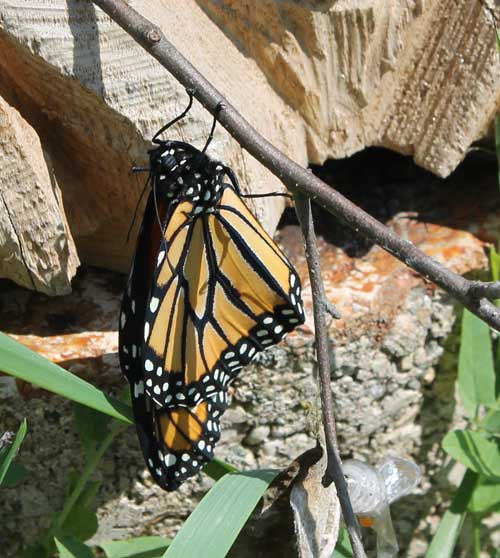
Terry put it outside for the wings to harden. Here it is at 2:20. Shortly afterwards, it was gone. We hope that it flew away and was not eaten by a bird.
![]() |
| Getting ready for flight |
Two days ago, the second one emerged early in the morning. Have a nice trip to Mexico, you two!
![]() |
| Emergence of our second monarch on Saturday |
The fruits are coming in. I’ve made the first six quarts of grape juice. The jars filled with purple juice have a quiet beauty in the afternoon sun.
![]() |
| Grape juice |
Raspberries are gearing up and should produce well until the frost. Kate came over for waffles and raspberries with real whipped cream a few weeks ago when the harvest was just starting.
![]() |
| Waffles with raspberries |
I’m staying plenty busy with the tomatoes as well. I found a
full-on rotter yesterday which launched me into a frenzy of blanching, peeling,
and de-seeding. I canned this morning. What I learned from this experience is
that rotten tomatoes can smell exactly like cat pee. I was initially mystified,
as we have no cat. The store room/tomato ripening area smells better now.