Friday, June 18, 2021

Rain at last!

 Today we are celebrating a half inch of rain that came in the thunderstorm in the middle of the night. It was the first measurable precipitation we’d had since May 22. That’s a long time without rain in these parts, and the 90°F temperatures didn’t help. At least it was a bit cooler this week. Now that we’ve had the rain, though, it’s not only hotter but wickedly humid. Ah well. At least we got some rain.

Jane had her shoulder replaced on June 8. Since we now have extra room, she stayed upstairs while she learned to do all her self-care with only her left hand. Skippy came to visit as well, since he couldn’t stay at home by himself. We thought that he would spend more time out of the cage upstairs with Jane than he does with us when he comes to stay with us while Jane goes to Florida. It turned out, however, that he was no more inclined to behave himself with Jane that with us and was quickly bored with sitting on Jane’s lap and started crawling under the chairs and pulling at the stuffing. So it was back in the kennel for him. Sometimes, though, he relaxed on the coffee table, presumably because the glass was cooler than other surfaces.

Skippy lounging on the coffee table

The chicks are growing fast, as they always do. Their wing and tail feathers are coming in, which means they will be flying all over the place soon and will need their wings clipped. Now that the ground has some moisture, we can install the chick fence and let them out into the run. That will give me an opportunity to replace the pine chips inside the coop, not that it needs it. In this picture, you can see that the Dominique (black) is quite a lot smaller than the meat chickens (tan). Every time I look or—God forbid—step into the coop, they all crowd into the corner farthest from where I am. They don’t call them chickens for nothing.

Rapidly growing chicks cowering in the corner of the coop

The outside garden is coming along. Meanwhile, the high tunnel is amazingly productive. I expect much of it is beginner’s luck. I am astounded at how many cucumbers we are getting. I have one of the plants trellised to string over a purlin. The idea is to use string that is made of natural fiber, in this case cotton, so that at the end of the season, I can cut the string and compost the whole shebang.

Cucumber trellised on a string hung over a purlin

The high tunnel carrots could be harvested any time, but I think I’ll wait until they are a little bigger.

The first high tunnel carrot

The Early Girl tomato has considerable foliage. I’ll have to do some pruning soon. It also has golf-ball-sized green tomatoes. I eagerly await them turning red.

Early Girl tomato plant

Here’s the peach tree.

High tunnel peach tree

The cherry took so long to leaf out that we feared it was dead, but it did eventually show some green.

The not-so-leafy cherry tree

The zucchini and watermelon are going crazy, especially the watermelon. I am considering trellising some of the shoots. I don’t think the string would support a melon. My plan would be to cut the flowers off those shoots so that their energy would go to the fruits developing on the ground. It will be a learning experience.

Zucchini and watermelon spreading everywhere

The first baby watermelon

I think it was last year that I mentioned the sexual dysfunction of my zucchini. Once again, the female flowers developed first. This is bad because if they aren’t pollinated, they get about 3” long and then rot if they are not picked promptly. It would make so much more sense for the male flowers to open first. As we say in the business, pollen is cheap and eggs (or fruits in this case) are expensive. All the wasted resources in the virgin zucchinis! I noticed this morning the we finally have some male flowers, so I can let the fruits get bigger now before harvest.

Finally, a pollinated zucchini

My main activity outside the high tunnel is pulling weeds right now. That is how I usually spend June. The weeds don’t seem daunted by the drought at all. Maybe now that we’ve had some rain, the fireflies will come out. Also the mosquitoes, but they aren’t as fun.

Sunday, June 6, 2021

Here a chick, there a chick

 So hot. So dry. So damn much wind. Not likely to change for a couple more days at least. We’ve finished up planting most of the garden. I’m waiting for a cooler, cloudier, less windy day to plant the basil. Basil is such a wussy plant. With the plants and seeds in the ground, we spend a good portion of our day watering, watering, watering.

Still, the garden looks pretty darned good, if I do say so myself. This picture shows the potatoes and tomatoes. The row cover (white) is over the cabbage plants and green bean seeds, not yet sprouted. I normally put on the row cover to keep off the bugs and keep the plants a little warmer during those cool early summer days. HA! At least they still have the bug protection. And some protection from the wind. You can just see the garlic peeping over the row cover in the back.

Our garden

I planted another batch of radishes. I laughed when I took a close look at this packet of seeds. The funny thing is that I don’t recall ordering Roxanne radishes, and I’m sure I didn’t order Silor cucumbers. This is why I always check the “no substitutions” box on the order form.

Odd substitution

The high tunnel is looking good. I’ve got two Crimson Sweet watermelon plants, three peppers designed for greenhouses, three tomato plants, and some Brussels sprouts, in addition to the peas, green beans, lettuce, carrots, beets, and herbs that I’ve previously reported. Will this be the year that I can keep a watermelon plant long enough to get a truly ripe melon? Stay tuned.

The high tunnel

The first planting of peas is wrapping up while the second planting is hitting its stride. We had enough peas for a decent-sized serving for two people today. The idea of the high tunnel is “succession planting.” One is supposed to plan ahead for what can be filled in where as each planting senesces. When the first peas are done, for example, I’m going to pull them off the trellis and train my baby cucumbers into that space. Speaking of, I harvested the first two baby cukes yesterday. The one we ate was exceptionally delicious, likely because we haven’t had a decent cuke since last year.

The first two baby cucumbers

The high tunnel does attract a number of not-very-bright visitors, such as birds and butterflies. They always fly for the top, which is exactly where there isn’t any opening. The birds have all managed to get out by themselves so far. This lovely black swallowtail didn’t make it out on its own, but it was cold enough the next morning for me to pick it up from the edge of the raised bed and put it outside. After a few minutes in the sun, it was on its merry way.

Black swallowtail

It’s too bad Hilda is gone because we have finally gotten the hang of growing strawberries. Last year, we learned that if a strawberry touches the ground, it will rot instantly. So this year, I put lots of straw under the berries, and they are just beautiful! Wait. Straw. Berries. Strawberries. More than coincidence?

Yesterday's strawberry harvest

The big excitement of the week was the arrival of the chicks. They were supposed to ship on Monday, Tuesday, or Wednesday. But Monday was Memorial Day, so I figured that was a wash. Nothing on Tuesday either. I had an email on Wednesday that they were on their way! Thursday morning, I tracked the package to Minneapolis at 5:55 p.m. Wednesday night. When I didn’t get a call from the post office by 8:00 a.m., I called to see if there was any chance they would be in Harvard at all that day. The guy said that maybe they might get to Woodstock, and they would call to give me the option of driving in to get them. He assured me that the drivers were always careful to put any package of live animals up in the front with them, out of the heat.

So I waited. No call. By the end of the day, they were in Chicago. Chicago! I was up early again Friday morning, and the call came at 6:15. I was so anxious about their welfare that I hardly even thought about Hilda’s absence. The chicks were all fine. I dipped their beaks in water for their first drink, as always. I’m sure they were thirsty after their long trip. Soon I had them settled in the brooder box working on their first meal.

Chicks in the brooder box on their first day

Here’s 17 seconds of baby chick cuteness!


The layers for this year are three Dominiques, which all look alike.

One of three Dominiques

The Americauna (the blue-egg layers) are all different, and none of them will be white. That’s good. Chickens are kind of racists. Put another way, birds of a feather truly flock together, and they don’t take to chickens that don’t look like them. The lone white Americaunas that we’ve had always get picked on unmercifully. Poor Bianca finally died, as I have chronicled in this blog, and I don’t want to talk about it.

One Americauna

Another Americauna

The third Americauna


 In other news, the chipping sparrow eggs hatched a week ago. On Sunday, they were just little fuzz balls.
Newly hatched chipping sparrow fuzz balls

By Wednesday, they were begging for food whenever they felt their nest move.

Chicks go through a phase where they are all mouth

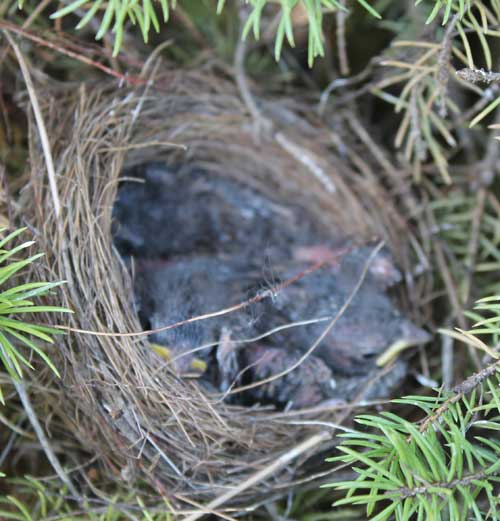
Yesterday they were covered with feathers. I felt bad getting this picture because one of the parents arrived just ahead of me with a big, juicy caterpillar in his/her beak. I backed away, but she still just flitted nervously around while her chicks went hungry. So I went in for a quick pic, and got out of there.

Feathers are coming in

More poppies are blooming. I love poppies. I posted a picture of one with yellow pollen and white stripes. Here’s the more common version with the black stripes and dark pollen.

The more common colors of poppy

I’ll wrap up this week with another picture of the doe and fawn. I got up to see if the hens were in bed, and saw what looked like a tall, thin dog in the middle of the field. Nope, it was the week-old fawn! Soon she and her mom strolled right by the garden, like they wanted to be sure I saw them.

Doe and fawn


Saturday, May 29, 2021

Early morning surprise

 I did not intend to get up at 5:00 this morning, but that was when Terry came into the bedroom to announce that a doe had just dropped her fawn at the far end of our field. It was too far away for great pictures. I have not cashed in my retirement savings to get a Really Big telephoto lens yet. By the time I had my camera, the doe had licked the baby and nudged it until it was on its feet.

Nudging the baby to its feet

A better view of the fawn

The baby nursed for just a moment.

Breakfast

It then went off to play.

And off to explore the big new world!

That was quite an exciting start to the day!

Last week Terry found a tiny nest with “jelly-bean-sized eggs” in one of his dwarf Alberta spruces. I did a stake out, which took about 30 seconds, and identified the parents as chipping sparrows. I haven’t been back to check if they’ve hatched. I’d be devastated if I found out that a racoon got them.

Chipping sparrow nest in a dwarf Alberta spruce

I took a picture with a ruler for a size reference. It seems that the eggs are about 1 cm long. Very cute.

Sparrow eggs with ruler for size reference

I have seen both male and female orchard orioles, but only the male hung around for a photo op.

Orchard oriole at the jelly

The irises and columbines have bloomed.

Iris

Columbine

I’m excited that the first poppy has opened up in my pollinator garden. There are many more ready to go soon. I love poppies! I note that this one has white spots and yellow pollen. Last year most of them had black spots and dark pollen.

First poppy

I am learning that things grown in the high tunnel can reach unusually large sizes. Look at this spinach leaf!

Giant spinach leaf

I don’t know if the large size is because the plants are sheltered from the wind or because it is like a hundred damned degrees in there every time the sun comes out

I also harvested a whole lot of oregano and thyme, which is now in my dehydrator. I normally wait until the last moment, when the herbs are all full of holes from little critters, but not this year. I realize that in years past, the herbs were ready for harvest at the same time as everything else, but no more. We’re months ahead of schedule.

A bin full of oregano with thyme in the upper left corner

I’ve been picking peas from the high tunnel also. Here is the first picking. I threw them in a stir fry with some of the giant spinach and enormous “baby” bok choy. The high tunnel is certainly a lot of fun so far!

First picking of peas--maybe half a cup.

Saturday, May 15, 2021

Spring goes on

 Somehow spring progresses even without Hilda. I took a walk back to the creek last week. She loved it back there, and she would have been delighted to see all the violets blooming in the grass.

Violets in the grass by the creek

In addition to being delighted at the grass and violets, I was delighted in the absence of the dreaded garlic mustard. We really do seem to be winning the war, not by pulling it all up, which would take forever, but by weed whacking it before it flowered two years in a row. Garlic mustard is a biennial, so the first year of weed whacking, the two-year-old plants will fail to set seed while the seeds in the soil sprout into immature plants. If those plants also cannot set seed, there will be no plants in the third year. This will only work if there is no seed bank, which is seeds that lurk unsprouted in the soil for more than a year. Evidence suggests that our soil does not have much of a garlic mustard seed bank.

My jack-in-the-pulpit came back, but does not appear to be spreading. My friend Huck just brought me two more jack-in-the-pulpits to plant in Hilda’s memory, which I have done.

Jack-in-the-pulpit. The orange is plastic tape to keep Terry from weed whacking it.

The mayapples, on the other hand, are finally starting to take off.

Spreading mayapples

Up by the garage, the trillium that I transplanted from Camp Pokonokah Hills many years ago are doing well. This brings me a great deal of joy. I will probably divide them this year or next. I haven’t picked a place to put them yet.

Trillium

Lots of fun things are happening in the high tunnel. The first planting of peas are flowering. It won’t be long before we’ll have swelling pods. Because I have no idea how many plants it takes to make a serving of peas, I won’t be surprised if we have three peas apiece for our first meal.

Pea flowers in the high tunnel

I planted two cucumbers in the soil of the high tunnel. One germinated and is growing ever so slowly. I planted three in a pot in the house, and they are growing like crazy. I soon had to transplant them to the high tunnel because they outgrew their pots.

The cucumber that germinated in the high tunnel on the left; one that I started indoors on the right

I have been carrying on with the tomato and pepper seedlings as best I can without Hilda's guidance. I haven't killed any yet, and the germination was nearly 100%, much higher than I anticipated when I planted two or three seeds per pot. Thus I have roughly 2.5 times the number of seedlings that I need. I hate making those life and death decisions.

Seedlings in the greenhouse

We had a little rain two weeks ago. We need more quite desperately. We thought we might get some this morning, but so far it’s nothing but a drop here and there. “Nuisance rain” Terry calls it. The last rain provided evidence of my suspicion that raccoons go over every square inch of the property every night.

Raccoon prints by the patio

More of our bird friends have come back. The first rose breasted grosbeak I saw looked pretty moth-eaten, perhaps a first-year male. I don’t know how much mating success he’s going to have with such washed-out plumage.

A not very rosy rose breasted grosbeak

The second male I saw was more typical.

A better specimen of grosbeak manliness

We have seen both male and female Baltimore orioles. I have only seen a male orchard oriole, and never long enough for a picture.

Male Baltimore oriole

Three white crowned sparrows have been hanging around longer than I expected. In previous years, they have come and gone almost as quickly as the white throated sparrow.

Three white crowned sparrows

We are finally seeing hummingbirds. Just this morning, I saw two on the feeder at the same time. Normally, they spend more time chasing each other away and defending their turf than actually drinking. It seems maladaptive. In this case, the female was first, but she held her ground when a male approached. She does seem to be regarding him with some suspicion.

Female hummingbird, right, regards an approaching male suspiciously

She even stayed while he settled in for a drink. Maybe this was their first date.

Still not quite sure about this guy, but letting him perch anyway

Oh, those turkeys. Two toms looked like they had a female interested. She walked right in front of them…

A female walks in front of two toms.

And kept going.

Hey! Where are you going? Come back!

Then headed back, and walked away for good.

Wait! Don't go! Check out this plumage!

The two toms then displayed to each other as if asking each other if they did or did not look sexy, or perhaps where they should try their luck next.

Do I look okay? What should we do now? I heard there were some babes across the road....


Friday, May 7, 2021

Farewell, Hilda


Hilda Norine Campbell Dow

October 22, 1930—April 25, 2021

Hilda on her 90th birthday last October

“I’m not going to put up a Christmas tree this year,” my mother announced in November. “It’s too much work.”

“Of course you are having a Christmas tree,” I said. “I’ll help you decorate.”

When we found out Hilda had a large malignant tumor on her colon in early December, she changed her mind. “Since this will be my last Christmas, I suppose I’ll have to have a tree.”

Once the tree was up, Hilda told me several times a day how much she enjoyed the cheerful colored lights. A week after her colonoscopy, she fell in the coop and cracked her collar bone. She had to sleep in a chair in the living room, and we kept the tree lights on all night. They made a good night light when she had to go to the bathroom.

We had to take the tree down before she came home from the hospital on January 5. The doctor had not been able to remove the tumor because it had already invaded her liver and pancreas. He re-routed her colon around the tumor. She was discharged to my care with Hospice support. We put the hospice bed where the Christmas tree had been, in the living room by the west windows overlooking the field, the apple orchard, and the fifth oak. I hung a string of colored lights in the window. She liked that.

She got better as she recovered from surgery and then worse as the cancer sapped her strength and energy. Doug and Pam brought her flowers and a balloon for Valentine’s Day. She loved that balloon. She marveled at how perfectly round it was, the result of it being made of four panels. She wouldn’t let me get rid of it even as it started to deflate. She kept it by the bed where she could play with the ribbon, pulling the balloon down and letting it rise up again. Throughout her life, she retained child-like joy in small things like balloons and Christmas lights. I admired that. The Hospice booklet said that as death approaches, the patient will often start talking about travel. Hilda wasn’t sure where she was going, but she asked me if she could take her balloon with her.

“Absolutely,” I said. When the time came, I did a ritual sacrifice of the balloon, sending its remaining helium to be with her. I couldn’t just set the balloon free. Mylar is very bad for the environment.

Hilda's view from the hospice bed--back yard, Christmas lights, Valentine's balloon and dragonfly suncatcher

It is difficult for me to write an obituary for my mother. We have a 62-year history, after all. So many memories.

It is amazing to think of how much changed during the course of Hilda’s life. She was born at the beginning of the Depression. Her father left school after 6th grade. Her mother made it to 8th. In spite of their own lack of formal schooling, they valued education and encouraged their first two children to go to college. Carl went on to get a Ph.D. Hilda got a Masters. Dick, the youngest, finished high school, went into the army, and then returned to work the farm with his parents.

Hilda grew up without indoor plumbing, central heat, vaccinations, and antibiotics. They had a goose who hated everyone except my grandma. Hilda had to take a stick with her to the outhouse to fend off goose attacks.

She got her first ball point pen as a gift when she graduated from high school. Her teaching career began in 1952. She taught every elementary grade before settling on fourth grade as her favorite. She always said that she could tell the difference in students before and after televisions became common. Attention spans got much shorter. It was a good thing she retired before cell phones were invented. I wasn’t that lucky.

Hilda touched hundreds of lives over her 30-year career. It’s hard to see any accomplishment as a teacher. You do your best with every student, sometimes succeeding, sometimes failing, but hardly every really knowing how anyone turns out. It’s like standing at the edge of a lake chucking in pebbles. The waves ripple out, interacting with other ripples, disappearing from sight. You just have to believe that it mattered somehow.

She did get to see how Doug and I turned out, and she was proud of us. She was always game to try something new. For example, she endured and even participated in my interest in wild foods when Euell Gibbons published Stalking the Wild Asparagus. We helped her in the kitchen and garden from the time we could stand. We couldn’t have been much help and probably made more work for her, but she understood that letting us help when we were young enough to want to would set a precedent for doing our part to run the household when we were surly teenagers. Most importantly, we always knew we could count on her unconditional love. She was a great mom.

Hilda was a big fan of my writing. There is an entire file drawer in her bedroom filled with the letters I’ve written over the years. I knew she was in decline when I couldn’t get her interested in reading my blog posts any more. She had always dropped whatever she was doing to run to her computer after I told her I’d posted an update. She would read it and say, “I LOVE your blog!”

These last seven years living with Hilda were a great gift. It was a privilege and an honor to care for her in her final months. My goal was to keep her at home until she died and know that I’d done as much as I could. I can put a big check mark by that one.

All Hilda ever wanted from death was eternal rest. As exhausting as the cancer was, I’m sure eternal rest was more welcome than ever. Sleep well, my dearest Hilda. I will love you forever.