Sunday, June 15, 2014

The homes we'll never own


Despite being on my summer break, I had a very busy week and have not had an opportunity to follow up on my birthday until just this minute. I was in a meeting most of the day Thursday. The most valuable thing about that was a free lunch. Thursday evening I was out celebrating the end of Leadership Greater McHenry County (LGMC) at our official graduation. On Friday the 13th, Hilda and I gave Coop 1 a thorough cleaning in the morning, and I drove to Elgin to help Jane get her mom’s house just about ready to be listed with the realtor. At the end of the day, I went to a restaurant in Algonquin for an informal celebration of our LGMC graduation with my cohort. The first problem was that road construction has made it nearly impossible to get from Elgin to Algonquin. After two detours, I got to the restaurant and then spent 15 minutes looking for parking. I finally found a spot on the street and began the trek to the restaurant. Just as I was carefully stepping around some vomit on the sidewalk, a redwing blackbird swooped down on the back of my head and clawed my scalp. I am not making this up. I must have infringed on his territory. I was not injured but was certainly surprised.

Anyway, back to Wednesday. We got to Lake Geneva in plenty of time to pick up our tickets and get on the boat.
Fountain by the entry to the boat dock
 
Despite the cold, cloudy weather, we opted to sit upstairs in the open air. We were the only people up there for most of the cruise.

Boarding the boat

Group shot before we moved to the upper deck--Jane tried twice, but having everyone look at the camera all at once seemed beyond our ability
Terry looks out from the front of the upper deck
 
Our tour guide introduced himself as a college student between his junior and senior year at UW-Whitewater. He wanted us to believe—without any supporting evidence—that he was an interesting person. He encouraged us more than once to ask him anything about himself. He also intimated that he was available. The fact that nearly every woman on the cruise was old enough to be his grandmother made his flirtatious remarks more than a little creepy. His alleged attempts at humor centered on midnight trespassing forays on the grounds of the palatial estates we saw on the tour. So not funny. Twit. “The bar is open,” he said. “The more you drink the funnier my jokes are.” There’s not enough alcohol in the world.

We pulled away from the dock and started around the lake. Twit kept saying, “On your right, you can see…” Lake Geneva is a big lake. Moving in a counterclockwise direction, everything is going to be on the right. It seemed redundant to mention it.

In between the bad jokes, however, the twit gave us some genuine information about the homes we would never own. Property values ran at tens of thousands of dollars per linear foot of shoreline. Taxes are upwards of $100,000 per year. Think about that a minute. Yes, I’ll just sit right down and write a check for $100,000, put a stamp on the envelope, and send it to the assessor’s office. Most of these mansions are summer homes, by the way.

After we passed downtown Lake Geneva, we came to a bunch of homes on the sprawling Wrigley Estate complex. We heard the story of Wrigley’s fortune in chewing gum and how he built homes for various relatives and friends. I had thought that there was one Wrigley mansion and that it was on the other side of the lake.


One of the Wrigley homes (I think)
Lake Geneva was settled primarily by filthy rich business owners from Chicago. Most of the original mansions either burned down or were demolished to build more modern homes. Here are some examples of the homes we saw:


Seriously, just look a the size of these babies!
This house has a pond in front (that's water in the middle of the rock boarder) because the lake is just not enough.

Many homes had terraced gardens down to the water
 
We came to a strip of closely built and less ostentatious houses of the Elgin Club. This homes were built on land purchased by a group of businessmen from Elgin.

Houses of the Elgin Club
As we came into Williams Bay, we could see the Yerkes Observatory dome peeking out above the tree line. This observatory, operated by the University of Chicago, has the largest refractory telescope (40 inches) used for research. The telescope was demonstrated at the 1893 World’s Columbian Exposition in Chicago before being moved to Lake Geneva to get away from the light pollution of the city. Many famous persons have visited the observatory, including Albert Einstein, Edwin Hubble, and Carl Sagan.

Yerkes Observatory
In the bay itself, several (presumably freezing) young persons were taking sailing lessons in three small boats accompanied by a larger mother ship.

Sailing lessons
There are still several camps along the shores of the lake. Most were established in the 1880’s to bring poor children from Chicago to have a wilderness experience.


Holiday Home Camp, established in 1887
Twit explained that all the docks around the lake have to be taken in for the winter. Having grown up on a lake, this was not news to me. I recall it vividly as a pain in the neck. On Lake Geneva, of course, the home owners have people for that. It is, in fact, a $6 million industry. Six million!

One of the boat in the pier service industry
Toward the end of the tour, we came on the mansion that I always thought belonged to Wrigley. It was really built by Otto Young, an entrepreneur who bought up the “worthless” land along State Street after the Chicago fire in 1871. Contrary to popular belief at the time, Chicago was rebuilt, and Young made a fortune. He spent a million dollars building the structure at the turn of the 20th century. If I remember correctly, Young died just a few years later. His heirs kept it for a time. It was donated to the Episcopal Church for a short-lived school in 1939 and sold for back taxes in the 1980’s for $74,000. After several unsuccessful business ventures, it is now divided into 6 luxury condos worth well over a million each.

Youngsland, the mansion of Otto Young
As we pulled back into port, Hilda asked, “Do you think this is one of those tours where you are supposed to tip?”

“I’m not tipping him,” I said. He had just told us that the view from the pool of a house on the top of a hill was nice at 1:00 in the morning, but you have to watch out for their dogs. Trespassing was still not funny.

But others did tip. I exited among of group of grandmas and gathered from the conversation that Betty had given the guy a ten to split with the captain (another undergrad who had done part of the narration), and everyone in the group was supposed to give Betty one dollar to pay her back.

The tour was over at 3:00. Our dinner reservations were at 5:00. We drove 3 miles north of Lake Geneva to Northwind Perennial Farm. While the driveway from the road was easy to find, the parking lot was less so. Signs directed us down a gravel road for some distance to the entrance.

Northwind is a laid-back place. Gardens with interspersed sale tables spread among old barns and repurposed outhouses. Exactly where one paid for the plants was not obvious on the first pass. We looked through some value added items (objet d’artsy-fartsy, antiques, etc.) in a barn that smelled strongly of cat urine. One of the offending cats sprawled on a table outside. I puzzled over a “diamond” hoe hand-forged in Holland and attached to a very long and heavy pole. It was an elongated diamond shape about 2” wide where it attached to the pole, tapered to 3” long points on either side, and sharpened front and back, apparently so one could push it or pull it. Even if I had not deemed it too heavy for practical use, the $90 price tag would have put me off.

Entrance to Northwind Perennial garden--that's a red bird house at the top
Overall, though, it was a beautiful place. They had mayapples growing in a wooded area, but  none for sale. Jane bought some dill because she doesn’t have it coming up all over like I do. The purchase transactions were conducted in a small building to the side of the main path. It was the only new structure I saw. I was tempted by their vast selection of native plants but held off. I need to have a plan before I start buying.

Allium in bloom

Bleeding heart in front of an old outhouse

One of many gardens

Geraniums by an old barn


Former outhouse now displaying a cactus, a Mexican, a burro (only the back end is visible in the photo) and the Last Supper
In addition to cats and dogs, chickens roamed freely. I found the little black rooster fascinating. Such a scrawny little thing.


Free range chickens with tiny rooster on the left
We didn’t quite fill up all our time at the gardens. The Tuscan Bar and Grill was happy to seat us at 4:30, however. We were the only guests in the place at the time. We had a nice meal. Most of us chose soup over salad because we were still feeling chilled from the boat ride. We warmed up as we dined and sipped wine. I was sure to save room for dessert. My triple chocolate cake was delivered with a candle on top.

We were home early. Between the cold, the fresh air, and the wine, I was ready for bed at 7:30. I made myself stay up until 8:30 so I wouldn’t be wide awake at 3:00. It was a very fun birthday.

Wednesday, June 11, 2014

Chicks may safely graze

How fickle the heart is. In spite of my grief over the weekend, I find my chest swelling with joy and delight as I watch the antics of the new chicks. I mentioned in my last post that a few chicks were out of the coop by Saturday night.
Lizette and three Buff Orpingtons were among the first out of the coop

Monday most of them were out and about. They love to explore the vegetation. They alternate between being off on their own pecking at the grass, having little territorial tiffs that are quickly over, and spontaneously running like hell for no apparent reason. Lizette (the white one) seems quite partial to dill.

Lidia, who started out with very dark down, is now tan with black accents. Of our known hens, she and Lizette spend the most time outside. The Buff Orpingtons like to be outside more than the Welsummer.
Lidia

Nadia and Gracie like to hang out by the warmer. Perhaps they will spend more time outside when the weather gets more summer-like. Maybe their little heads get cold under their Mohawks.
Nadia and Gracie by the warmer (the underside of the platform is heated to simulate a mother hen)

Happy birthday to me! Last year I spent my birthday doing not fun things. Terry and I moved Coop 2 into position on the lawn, which was a long and exhausting process, and we moved the broilers and Jackie from the garage to the coop. I also put the drip irrigation on the garden. I mentioned recently how much I dislike that task. At the end of the day I promised myself that this birthday would be FUN.
I have already had a nice gift. It was raining when I got up. This not only provided much needed water for our garden but also got me off the hook for weeding before it was time for our Big Adventure of the day. I have spent a pleasant morning drinking tea and doing not much else.
Jane will be here at 11:00. After an early lunch of shrimp salad graciously provided by my mother, we will all go to Lake Geneva to take a boat tour. I have had this on my list of things to do for close to 30 years. Today is the day. The weather is cool and gray, but the rain has stopped here for the moment. Lake Geneva isn’t too far away, and I hope the rain has stopped there as well. In any case, the boat is not likely to be crowded, and the lower decks are completely enclosed in case it is wet.
After the cruise, we may go up to Northwind Perennial Farm. Jane has heard about it from several people. We have some time to kill before our 5:00 dinner reservations.

Stay tuned for more about my FUN day!

Sunday, June 8, 2014

Moving day


When we got back from dropping the hens off yesterday, I had to have a cup of tea to restore myself. After that, we started in on moving the chicks to Coop 2. Yes, we could use Coop 1, since it is now empty, but we moved Coop 2 into position and got the fences up before we came to grips with the hen situation. We figure that as soon as we can tell the boys from the girls, we can move the girls we intend to keep over to Coop 1 for the duration. Besides, we can give Coop 1 a thorough cleaning and let it sit empty for a bit, just in case there are any disease-causing organisms lurking.

This is the first year we’ve been able to move the chicks as soon as they were ready. For the last two years, we’ve had to build the coop first. I know now why the books advise building the coop before the chicks arrive. You will not, in fact, have plenty of time to do it later.
We chased the chicks back and forth in the enclosure without much success in grabbing them before we figured out to put one of the screens vertically between the walls to trap the chicks on one end. It went better after that. We developed a system in which Hilda held the screens, I grabbed the chick and clipped its wing, and Terry opened and closed the plastic transport bin. We didn’t have to worry about wing clipping last year. The couch-potato broilers got so big so fast they could barely waddle to their food. Flying was out of the question. Dual purpose chickens look to be physically capable of flight for quite some time.

Vertical screen to keep the chicks in a smaller area while the horizontal screen keeps them from flying out
Wing clipping is quick and painless, the poultry equivalent of a haircut. I spread the wing out and trimmed about an inch or so off the ends of the feathers. This puts the chick off balance. It can flutter a little but can’t get up a full head of steam. After I was done, Terry opened the bin so I could put the chick in it. He then kept the lid closed until the next chick was ready.

Hilda demonstrates wing clipping
We carried the bin out to Coop 2 when we had about half the chickens done. I help the bin while Hilda put them in the coop. We covered the door with a screen for the first day to get them used to their new home and hopefully teach them that that is where they belong at night. We repeated the procedure with the other half of the chicks.

Huddled in the corner of Coop 2 away from the door
If we’d had our brains properly strapped on, we would have remembered to move the chick warmer before we did the transfer. Oh well. We had to install it afterward. Hilda wanted to clean it off before we moved it, although I was hard pressed to understand why. She set about cleaning the garage while I mowed the lawn.

Two and a half hours later, the chicks were still huddled in one corner of the coop, quite possibly because they didn’t like the cool wind blowing through the door. As soon as I put the warmer in the coop, the chicks had a complete change of personality. They were climbing all over it and the coop instantly, as if the warmer was a signal that everything was okay. They started eating and drinking also. It was amazing.

We had a little rain overnight. We waited until the grass was mostly dry, about 11:30, to take out the screen. The braver chicks peered out of the door. None would try the ramp. I lifted a few of them out and put them on the ramp. They climbed right back up to the coop. I tried putting some grass on the first step to entice them out. They reached out to grab it and then played keep-away with it in the coop.

One of the Welsummers got to the top of the ladder inside but didn’t seem to know how to move to the roost. After teetering on the top of the ladder for a few seconds, it settled down right there.

I'm at the top--now what?
The day passed. I left at 3:30 to pick up the frozen chickens. It was harder than dropping them off actually. I am sad every time I pass the empty run and see Ina’s dust bath in the corner of the raised bed. I missed throwing them my carrot peelings, which has been part of my Sunday routine for close to two years.

The butcher lady met me when I pulled up. They were done butchering for the weekend and were just finishing the last of the cleanup. She told me there was a problem with one of the chickens.

“A black and white one, I bet,” I replied.

“He would know,” she answered, “but I have it right here if you want to look at it. Her whole belly was just full of stuff.” She opened a refrigerator and took out a bag. A few black feathers here and there confirmed my suspicions. It was Sara.

“We knew there might be a problem. If there weren’t problems, we wouldn’t have brought them to you,” I said.

We loaded the cage in the back of the truck and put the remaining seven hens in a cooler. The woman said, “They’ll be good eating. We could tell they’d been well taken care of.”

“Thanks so much for doing the dirty work,” I said.

Terry and I weighed each one when I got home. Five of them were 3.25 to 3.5 pounds. One was 4.25 pounds, and another was 5 pounds. The two fat ladies, no doubt. Frankly, they just look like food now. It’s a relief.

I check on the chicks periodically. Still no one ventured down into the yard.

My parents went to a concert and dinner this afternoon. When they got back, I went upstairs to report on Sara. Hilda asked, “How long have the chicks been out?”

“Are they out?” I was surprised. Sure enough, Lizette and four of the Buff Orpingtons were down on the ground, mostly hanging out under the ramp. It remains to be seen if they can find their way back up by themselves.
Here's the update on Nadia's head feathers:
Nadia is getting some wild hair!
And the robins will be fledging soon. I'm pretty sure only three of them made it.
 

Saturday, June 7, 2014

A difficult task


Jennifer, Clarissa, Sara, and Nigella enjoying their last sunny afternoon on Friday

Ina, Bridget, and Ingrid, ditto. They've had happy lives.
Many years ago, I heard a motivational speaker illustrate dedication and commitment with the following analogy: in a breakfast of bacon and eggs, the hen is dedicated and the pig is committed. With the dedication of our hens flagging, today we sent them off to make a commitment.

The day started off even worse than I anticipated. One of the Welsummer chicks developed wry neck (a.k.a. crook neck). Last weekend, we noticed that one chick went spastic with the excitement of changing the bedding. It lay on its side and spun in circles. When everyone calmed down, we couldn’t find Spaz again. We hoped for the best.

I researched “spinning chick” and didn’t come up with much. Perhaps a vitamin deficiency or an inherent neurological problem.

Yesterday, Hilda noticed that one of the chicks (we assumed Spaz), had a twisted neck. She put it in a box by itself. I did more research, finding the correct name(s) and some pretty dismal information about the disorder. It is often genetic, although it can be a vitamin deficiency or brain damage from pecking. I learned that Polish chickens are susceptible because their skull doesn’t close properly. Who knew? We’ve just been lucky there so far. It can also be Marek’s disease, but we had the chicks vaccinated for that. The vitamin deficiency also seemed unlikely because we’ve been putting vitamins in the water. If it is a vitamin deficiency, the treatment is to give vitamins three times a day for two weeks. Maybe it helps; maybe it doesn’t.

Welsummer chick with wry neck
Hilda and I agreed to just let the chick die. We hoped it would happen overnight. It didn’t. It looked horrible this morning, laying on its side in the box with its head twisted underneath it. I asked Terry if he would mind dispatching the chick. He said that would not be a problem. He would take care of it while we took the hens to the butcher.

We left the girls in the coop until 8:00. The butcher said we could deliver the hens any time today. We figured if we started at 8:00 we could be there by 9:00, giving them ample time for breakfast and coffee. Hilda hoped that we could have a quiet moment to hold each one, pet her, and say thank you and goodbye. The worked for the first couple. Then the rest sensed that Something was Up. Hilda had to grab them by the wings to get them to the truck. The only injury sustained was a scratch on my ring finger from Sara’s foot.

And yet, as soon as they were in the cage, they were quite calm. When Hilda and I got to the farm where the butchering operation is, the chickens were all sitting peacefully together like they rode around in the back of a pickup truck every day of their lives.

An extended family was in an open shed dispatching poultry with practiced efficiency. The rubber-fingered automatic plucker spewed feathers out the back. A young woman in her late teens or early twenties came out to help lift the cage off the truck. The last time we did this, they took the chickens out of our cage and put them in their own cages. Today, however, they didn’t have space. Everywhere I looked there were chickens, ducks, geese, and rabbits.

“Let’s put this over in the shade,” the girl said. I helped her carry the girls to the side of the driveway.

She recorded our order in a spiral-bound notebook. Did we want the giblets with each bird or in one big bag? With each bird. She told us we could have our chickens back frozen tomorrow. Hilda asked about that because the woman we’d talked to said the processing would be Sunday, and we would pick up on Monday. Freezing takes an extra day.

“Mom!” the girl called, “When can they have the chickens back frozen?”

An older version of the girl came away from the activity in the shed. “Since you are already here,” she told us, “we’ll do them today. You can pick them up tomorrow afternoon.”

We explained that they were two-year-old hens that had stopped laying and that one had died two weeks ago. The woman said that she could tell us what she found when they cut them open. “One time, we opened one up and it was full of something that looked like rotten scrambled eggs.”

Yolk sac peritonitis, I thought. At least they won’t care if one of our hens has it. They’ve seen it before.

Our hens sat placidly in their cage, gazing around with curiosity as if saying, “Well, this is different.” I patted Bridget on the head, and we went home.

Humans were not humans long before they imbued the nutrient cycle with spiritual significance. I can well imagine that if your only weapons are rocks and sticks, actually killing something would seem like a miracle. Either a god has sent the animal for you or the animal itself has chosen to die so that you may live. Some believed that eating the animal would give them characteristics of that animal. Fast as a gazelle. Strong as a bison. From there, it was not much of a step to believe, as the ancient Greeks did, that animals could possess the spirits of gods. A goat embodying a god would be sacrificed and eaten; those who partook would become one with the god. It is only in this context that the ritualized cannibalism of Christianity’s Holy Communion makes any sense. Communion = becoming one.

I expected that I would need to detach myself from the girls to make peace with what we had to do today. I am finding, however, that I feel better embracing my emotional attachment. We are going to achieve the ultimate oneness. Their proteins will become our proteins. If they were able to transmit some characteristic of theirs to me, it would be their ability to be present in the moment, to view everything that comes their way as the best experience they have ever had or ever will have, to wait tranquilly to see what each moment reveals.

I will dine with due reverence. Take; eat. This is my body which is given unto you.


Tuesday, June 3, 2014

Gardening


On to more pleasant things. In between chicken doctoring and cleaning out Jane’s mom’s house, we’ve been diligently putting in the garden. The fun part of gardening is putting plants or seed in the ground. I can almost feel the plants stretching their roots with relief and thinking, “At last we have room to grow.” The seeds can wake up and start their new life, sending up leaves to catch the sun and begin making food for themselves that will eventually turn into food for me.

The peppers in the ground
Then there are the part of gardening that suck. I love having drip irrigation, landscape cloth, and row cover in place. I hate putting them there. These three things are, to me, the secret to successfully gardening without chemicals. The drip irrigation is the most efficient way to water. The landscape cloth saves us hours and hours of weeding, or the alternative of spraying herbicide. The row cover uses the ecological concept of apparency to decrease herbivory. If the bugs can’t see the plants, they won’t eat them.

Peppers with landscape cloth and drippers
And so I take a deep breath and put them all in place. The irritating part of drip irrigation is that no matter how much you think you are setting out your plants the same way you did last year, the irrigation never lines up right. Even the drip lines, which are the easiest, are never quite the right length. The rows seem to get a little longer every year. In previous years, I planted the corn in rows that were two feet apart. This year, when I wasn’t looking, Terry planted the corn in rows that were three feet apart not, as I naturally assumed, to make my life a living hell, but because “we have enough room, and maybe they will do better with more space.” So now I’ve got to move the drip lines. At least every third one still lined up with a row.

Corn in 3' rows with drip line
I think that I have always planted the peppers two feet apart both within and between the rows, but there are always drippers in the wrong place. Or the connecting hose is mysteriously too short, and I have to add extension lines with ¼” hard plastic connectors that are kind of rough on the hands. After I’ve got all the drippers associated with a plant, I have to turn on the water and see if they work. Half the time, there’s an air bubble that has to be bled out before the water flows. I have to open up the dripper until the muddy water sputters and squirts all over my glasses. The main lines are black plastic. By the time I’m ready to do the final adjustments, the water has been sitting in the lines in the sun for half an hour or more. That means that the water spraying all over me is typically uncomfortably hot.

And every year I think I’ve ordered the last supplies I’ll ever need from dripirrigation.com, and then I can’t find enough goof plugs (which is what you need to stop up the hole when you move a drip line from one place to another), or I’m running seriously short on drippers, or something. The lifetime supply of drip line that I ordered last year is gone. I ordered another 500 feet. I hope it lasts until next year.

Sometimes a line comes loose over the winter. As soon as the water goes on, a fountain erupts from the main line where the hole is. You might think that you can put in a goof plug while the water is running, but you would be wrong. After giving myself a thorough shower, I turned the water off, put in the goof plug, and carried on.
Goof plug

The problem with the landscape cloth and the row cover is the wind. Hilda and I work together, but still there are times when I feel we will both be carried off with the fabric stretched between us like a giant kite. This afternoon was relatively calm, and we were able to get the row cover on the peas and beans before supper. We’re in pretty good shape now.
Row cover over hoops

The grid of landscape cloth where the tomatoes will be
Tomatoes with landscape cloth, newspaper, dripper, and cage--whew!

In other news, my wildflowers are doing well.

Wild geranium

Shooting star--one of my personal favorites
We have a robin’s nest in a dead Hinoki cypress (a Japanese tree that Terry planted as an experiment) near the garage. All four eggs hatched. This afternoon, I could only see three chicks, but one might have been underneath. Anyway, here’s a series of pictures from the last several days.
May 27, the first egg hatches
May 30, three eggs hatched
June 2, all four chicks hatched. The one at the top is getting real feathers while the one at the bottom barely had down.
And here's what the chicks look like:
Cleopatra--I think new feathers must itch. I see the chicks grooming themselves a lot.
Buff Orpington

Gracie

Gracie's topknot

Lidia

Lizette

Nadia--note how much whiter her wings are than Gracie

Welsummer


Monday, June 2, 2014

More chicken trouble


Saturday morning was my day to do chicken chores. I noticed with dismay that Sara was waddling, her belly swollen so much that it was displacing her legs. I picked her up. She was heavy, and the skin on her underside was stretched tight. I put on exam gloves. Once again, I couldn’t feel anything hard or sharp. She was not obviously distressed (when I didn’t have a finger in her cloaca). I put her back with the others.

Sara, looking bloated and unhappy
Hilda and I thought that we’d better consider having all the hens butchered. It seemed more humane than watching them die one by one. “Let’s give it until Monday,” I said.

The good news was that Gracie and Nadia have apparently outgrown their pasty butt problems.

I didn’t have much time to do anything more with Sara as Terry and I were taking his truck down to Jane’s mom’s house. Her dad had all manner of tools and workshop stuff that needed to be taken out. Instead of trying to guess what Terry wanted, I thought it would be more expedient to just have him go through it himself. Dave had already set aside what his sons had requested. Once Terry understood that anything he didn’t take was going to Goodwill, he started filling boxes with wild abandon.

Meanwhile, Dave and I loaded the truck with a hutch, two bed frames, two chairs, and a telephone table/chair combo (how quaint), and a couple of boxes and drove to Goodwill. Jane, Dave, Mary, and I discussed the two options. The Goodwill in South Elgin was closest, but was manned by an old guy who was not much help. The Goodwill in Carpentersville hired strong young men, but was farther away. “One guy picked up that table top all by himself,” Jane reported, and that’s saying something. I’d taken the table apart the day before, since I am the youngest and most agile. I lay on my back on the kitchen floor to remove the six screws that attached the top to the legs. It took two of us to roll it to garage and three of us to get it in Jane’s car.

In the interest of time, we went to South Elgin. The guy there was not only old but cranky. He went inside when he saw us pull up not, as I wrongly assumed, to get someone out there to help him, but to get a dolly that was pretty much useless. Dave and I unloaded the whole truck.

Back at the house, we loaded up all the stuff Terry thought he could use and headed home.

I did more research on chicken diseases. As best I could tell, Sara (and also Julia) were not egg bound, but had become “internal layers.” Long story short, they were suffering from a constipated oviduct. The eggs were no longer passing out of their bodies. Yolks, being very nutritious, eventually were invaded by bacteria. The resulting yolk sac peritonitis will kill the bird in 24 to 48 hours. One article I read said that the condition can be treated by spaying the bird. Seriously? Why would you spay a layer? Someone in a discussion forum said the quoted price for this procedure was $1500. Gasp. Plus you would have to know a vet willing to do the surgery. Antibiotics can treat the infection but not the internal laying. I was able to find some helpful drawings of chicken anatomy, from which I learned that the uterus is above the cloaca while the intestine is below. Some folks suggested soaking the chicken in a warm bath for 20 to 30 minutes and/or giving the chicken Tums as a calcium supplement. These two treatments supposedly work for unsticking an egg, which I was less and less convinced was the problem.

But we tried it anyway. Unlike some chicken owners, we were not willing to use the regular bathtub. We got a plastic muck bucket. Hilda filled it with hot water. I put in cold water from the hose until Hilda thought it was the right temperature for a baby bath. (How would I know?) We put Sara in and took turns holding her vent beneath the water. Sara had not read the discussion forum and did not know that she was supposed to feel happy and relaxed. At the end of 20 minutes, Hilda lifted her out, and I wrapped her in an old towel. Hilda sat on the low table we keep the feed on in the coop to hold the chicken in her lap while I fed Sara fragments of two Tums. At least she would have minty fresh breath if she died overnight. I gave her water in between, which she drank without much hesitation.

With the Tums gone, I did another cloacal exam, checking upward for the egg instead of down. Nothing. When I took my finger out, it was followed by a flood of watery poo.

“You’re gonna want to wash that shirt,” I said to Hilda.

“And the pants,” she added.

Watery poo is a symptom of internal laying. It is also a symptom of a hot day, which it was. Because of the hot, windy weather, Sara was perfectly fine being released back into the yard. Her feathers were dry within the hour. Folks who do this chicken bathing thing in the winter have to keep the chicken indoors in a warm place overnight to be sure she doesn’t get chilled.

“What do you think about putting them all down?” Hilda asked. “We haven’t had any eggs in 6 days.”

“I’m not liking this,” I replied, peeling off the gloves. I was spending far too much of my time on chicken butts these days. Any time spent on chicken butts is frankly too much.

This morning, Monday, I noticed one of the chicks was lethargic. Once again, I had no idea what to do. At least it did not appear to involve the back end. I fed the poor thing some watered-down yogurt with an eyedropper, thinking some probiotic bacteria might be helpful.

The Welsummer chick on the right was lethargic
I had to leave for a dentist appointment after that. I went down to Elgin to help Jane move the last of the stuff out of her mom’s basement. I filled up my car with more things I thought Terry would like. We worked steadily from 10:10 to 1:30, when Jane had to get ready for a doctor’s appointment. At that point, everything was out of the house and into the garage. Progress.

When I got home, Hilda reported that Sara was still going out into the run and eating Happy Hen Treats. I can only guess that the infection has not yet set in.

“What about the chick?” I asked.

“Oh, it was dead by 10:00,” she said.

Hilda called the butcher after 4:00. We will take the hens on Saturday for processing on Sunday. If they don’t die first. It is all very sad. And yet, it is also a rite of passage. I am taking one more step in my transformation into a farm wife. I know where my food comes from.


Memorial Day


My late-start online class finally ended last Wednesday, praise be. I’ve been so busy with everything that there has been no time to blog. Let’s start with Memorial Day, since that was a happy time.

Pat and Nancy came were scheduled to arrive at 10:00 in the morning to help build a fire ring back by the creek and collect downed branches for an afternoon burn. Terry had been piling all the rocks he pulled from the field back there. Before they got there, Terry got busy with the weed whacker clearing away the garlic mustard in between some box elder trees.

When Pat and Nancy got there, we got busy moving stones. Terry told us the dimensions (which were enormous) that he had in mind and started trimming branches with his chain saw. We filled in one ring of stones like I’d always done at the Girl Scout camp and set about collecting wood. Terry came back and said, no, he wanted us to use ALL of the rocks in the wood pile. Well. He hadn’t mentioned that at the staff meeting.

And so we started piling on more rocks. It went fast in the sense that we made many trips and piled many rocks up in the space of 20 minutes. It went slowly in the sense that there were always more rocks. We decided to work until noon, when we would go back to the house for lunch. After lunch, we would collect more wood. We’d start the fire when Jane, Dave, and Mary (Jane’s brother and sister-in-law) got there. Dave, Mary, and Jane were taking a break from cleaning out their mom’s house.

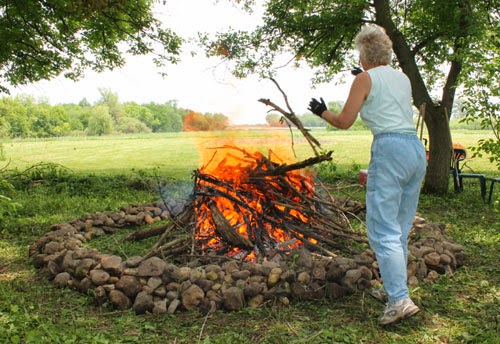
At the end of an hour, we had not a fire ring, but a fire wall!


Starting the fire inside the stone fire wall
The fire got enormous, of course, and we had to keep moving our chairs back. At the proper distance, it was pleasant in the shade with the breeze blowing.

The fire when it got going

Nancy throws a big stick on the fire

Pat feeding the fired
We spent all afternoon clearing the woods and burning. We went up to the house for supper. While a cookout always seems like a good idea with a bonfire, the reality is that you would need to have 20-foot roasting sticks.

It was a very pleasant day and evening. We lingered over dinner, talking and laughing. All was right with the world.