Friday, May 5, 2017

Earth Day, 2017

Pat, Nancy, and Jane came up for a work day on April 22. All the week before we watched the weather reports. Early in the week, rain was in the forecast. As the days went by, the predicted rain disappeared. The day could not have been lovelier. Blue sky, bright sun, rapidly rising temperatures. We started in the greenhouse. Pat and I had gotten some seed kits that we wanted to start. The lisianthus that Hilda started months ago were ready for the big pots, which would be shared among Hilda, Jane, and me. Here we are filling pots with soil.
Pat, Nancy, Hilda, and Jane filling pots with soil in the greenhouse

Here are the lisianthus in their big pots. Everything had to stay in the greenhouse. It was hard to believe it would ever be cold again, but our frost-free date is in mid-May.
Lisianthus potted up and ready for the patio after the danger of frost has passed

We took a break for lunch and then started on the real work. My goal for the day was to get rid of some massive buckthorns. Buckthorn, if you are not familiar, is a wickedly invasive, wickedly thorny small tree. They don’t get tall, but they develop large crowns that produce small, black fruits by the thousands. The seeds are very efficiently dispersed by birds. The species name is Rhamnus cathartica. Need I say more?
The trouble with buckthorn is that if you just cut the tree down, it comes back as stump sprouts. Terry’s plan was to clear out around the largest of the buckthorns so he could get at the trunk later. He would cut notches all around and pour in herbicide to kill the tree. After it dried, we could cut and burn it. He got his chain saw and took Pat to help him haul out the brush around two giant buckthorn growing in the wetland. The rest of us went back to the creek with clippers and hatchet to clear out the smaller buckthorn growing there.
Terry had started a brush pile in the fire ring. With a hot enough fire, we would be able to burn the small trees and branches that we were clearing even though they were green. We also got rid of last December’s Christmas trees.
Pat and Terry watching our Christmas tree burn

My native plants were mostly doing well, although one of the Dutchman’s breeches had either not emerged or had been eaten.
One of the Dutchman's breeches

Mayapple
Trout lily
My second Jack-in-the-Pulpit came up, which I was glad to see.
The second Jack-in-the-Pulpit coming up to the right of the one that was up previously

When Pat and Terry were done in the wetland, Terry cut the brush and lower branches from around a large buckthorn by the fire ring. Here is Nancy going in for another armload of slash.
Nancy clearing brush from around a big, ugly buckthorn tree

We were quickly done with the heavy work and sat by the fire enjoying the beautiful day until 3:30 or so. Pat and Nancy wanted to go snipe hunting. I had not seen any snipes on my last walk through the south end of the property a few weeks ago, so I prepared them for disappointment. To give us the best possible chance of seeing one, however, I left my camera in the house.
Once we got down there, I thought I saw one take off in the distance. We walked through the muck and water to the far south end of the property. Pat said that she loved that feeling, and I agreed. Nothing makes you feel like you’re 8 years old quite like putting on your big rubber boots and splashing around in puddles. We started walking north through the unmowed area. A snipe took off with its characteristic wing whir and flight call. We took another step and flushed another snipe, this one so close we could see its long bill and the stripe on its side. Another step, another snipe. We saw 8 in all. We were all thrilled.
We had a nice supper together to cap off a perfect day. It was so good to finally spend some time outdoors after a long winter of rain and mud, and good to be with such wonderful friends. I made a rhubarb pie for dessert to celebrate one of our two first harvests, the other one being asparagus.

Sunday was also a beautiful day. I mowed the lawn for the first time. In the afternoon, we went to MCC for the band and chorus concert. When we got home, three tom turkeys were marching in formation straight for the house. They were after two hens who were eating sunflower seeds from the ground under the bird feeders. I got my camera from downstairs and was able to get this picture. 
Macho tom turkeys utterly failing to get the attention of two hens
I find the spectacle of tom turkeys strutting around in perfect synchrony hilarious, the epitome of macho posturing. The hens did not seem to be impressed either. The toms spent the remainder of the afternoon following the hens all over the hay field. We never witnessed any success, but we are still hopeful that we may see turkey poults before the summer is over. 

Monday, May 1, 2017

Tadpole development

All winter long, I struggle for blogging material. Not much shaking. Then spring hits, and I have so much to write and no time to do it. Hence the late post this week.
Before our tragedy with the chickens, you may recall that I witnessed the mating frenzy of the American toad. That was two weeks ago on Sunday. For the next two days, I deeply regretted not bringing in some eggs for observation. I go through the whole process in Ch. 43, and here I was passing up an opportunity to observe it firsthand. Tuesday night, I couldn’t stand it anymore. I found a half gallon mason jar in the root cellar, put on my Wellies, and set out.
There was not a toad in sight. Really? All over in a few days? Maybe even one day. I didn’t pay enough attention to the sounds. For a moment, I was afraid I would not even be able to find any eggs. As my eyes adjusted to looking at and in the water, I noticed masses of slimy chains of eggs gathered around the emergent grasses. I scooped up a handful and put it in a jar that I filled with water from the “fluddle” (a word I just learned from an article on chorus frogs meaning “puddle in a flooded field”).
There must be plenty of chorus frog tadpoles in the fluddle as well, because there were two in the jar.
A chorus frog tadpole with the toad egg mass, Tuesday afternoon
I had already missed the first several divisions of the eggs. They were no longer round, suggesting that the body plan was already starting to take shape.
Toad embryos already taking on their body plan, Tuesday afternoon

The next morning, some of the tadpoles had wriggled free of the slime casing.
Wednesday morning: A few embryos on the top of the egg mass

Wednesday afternoon, I had to stop at Walmart on the way home for an air pump, tubing, and an air stone. There was no way to get algae going fast enough to provide oxygen for all the babies. $10.73. Not too bad for research equipment. When I got home, more tadpoles were lying on top of the egg mass.
Wednesday afternoon: more embryos have emerged

Thursday morning, the tadpole embryos were standing at attention.
Thursday morning: Standing at attention

They were about the same in the afternoon.
Thursday afternoon

They started somehow climbing up and sticking to the glass Friday morning. They didn't swim much.
Friday morning: Clinging to the glass

They were very thin and looked exactly like the drawing in Ch. 43 for late gastrulation, just about the time that the digestive tract punches through at the mouth. I did think there would be more of a yolk sac in their little bellies. You may be wondering what the cheesecloth over the top is for. That is because there are mosquito larva in the water. Also daphnia and cyclops.
Friday morning close up. Seriously, what is sticking them to the glass?

Friday afternoon, there were close to a hundred. I counted up to 80 and gave up. They were swimming more now
Holy smoke! Look at them all!

Saturday was a busy day (more later); no time for pictures. I went out to the fluddle to get a handful of muck off the bottom to provide algae, bacteria, and whatever else tadpoles eat off the bottom. There are no true water plants in our vernal pond. There are grasses in various stages of living or rotting. Over the next several days, the tadpoles stripped them down to the veins.
Thus nourished, the tadpoles ballooned into their round shapes.
Sunday morning

I got a good picture of the chorus frog tadpole with three toad tadpoles Monday afternoon.
Chorus tadpole, lower left, with three toad tadpoles

Obviously, I couldn’t keep all hundred. I had to thin the herd. 
Tuesday, April 25: One week in captivity
Last Tuesday (April 25) was a lovely warm day. I would be able to release the surplus without cold shocking them. I picked out 7 toad tadpoles and the two chorus tadpoles and put them in a little container. Note the abundance of poop on the bottom. They were in there maybe 10 minutes. Pretty sure tadpoles poop continuously. It stands to reason that they must eat continuously also.
The keepers

While the captives were pooping, I took the jar out to the fluddle to liberate the extra tadpoles and fill the jar with fresh water and more muck and grass. And I brought in another tadpole. Boy, there must be a lot of tadpoles in that water. And yet, I never see them when I’m walking through.

Just one more thing. Terry and I, like any two people who share living space, have our disagreements, but I just gotta love a guy who doesn’t think there is anything weird about having a mason jar full of tadpoles on the kitchen counter. 

Sunday, April 23, 2017

Double murder

In the midst of spring renewal and new life, we are heartbroken over the deaths of Nadia and Gracie. A mink—probably the same one I saw at the creek last week—wriggled under the cage of the Home of the Chicken where there was a gap between the plywood wall and the soil ridge next to the garden. The enclosure we intended as a refuge ended up being a trap. By the time Hilda discovered him, both chickens were dead.
The last happy days of Nadia and Gracie. See the gap between the plywood and the sod?

I knew minks and chickens were not a good mix, but I never thought a mink would be so bold as to come after the hens in broad daylight. I thought they girls would be safe in their coops during the danger of the darkness. The hens from Coop 2 had been able to run away when the mink came. Poor Nadia and Gracie.
Hilda told me as soon as I got home. “Sit down,” she said. I’d seen Dad making supper in the kitchen, so I knew he was still alive. She explained what had happened that afternoon. I was stunned, I guess. I wanted to cry but couldn’t. Gracie in particular was my little buddy ever since I saved her life when she almost died of pasty butt as a chick. In the early days, she waited in the coop for me after all the other hens had run out in the morning. I would pick her up and pet her, then put her on the floor and shoo her out so I could do the chores. She was so funny and goofy. She crossed her feet when she ran. It was hilarious.
More recently, we saved Nadia from being pecked to death. We contemplated having them butchered before we decided to try the enclosure idea. They had just recovered their feathers and started to lay, and now this. At least they probably didn’t suffer. I’m sure the mink was every bit as efficient a killer as our butcher.
Thursday night at dusk, I went out to shut and latch the door of Coop 2. When I saw the empty Little Red Hen Barn and run, the sadness welled up in me and burst forth in great sobs. As much as I hate the headache that invariably follows, I was relieved to finally have the good cry that I knew was coming.

As the days have passed, I’ve come to accept the loss. It was hard to not keep going over what we should have done differently. We could have kept them in the upper run. We could have even let them use the big coop and the whole run. I always felt a little guilty about the tiny space they had in the Home of the Chicken. We could have dug in the plywood around their cage by the garden better. We could have electrified the fence around the garden. But we didn’t. And they’re gone. And that’s all there is. 

Monday, April 17, 2017

Love fest of Bufo americanus

I went for a walk after lunch on Sunday. The rhubarb may be ready for a pie next weekend.
Rhubarb nearly ready for harvest

The asparagus is slowly starting to sprout. I harvested 5 spears, which I threw in a stir fry tonight.
The first asparagus

I went down to the vernal pond by the willows. I have been trying to years to catch a glimpse of the tiny chorus frogs that serenade us 24/7. (Don’t they get tired? Do they sleep? Sing in shifts?) I was pretty excited when I saw the water moving in the pond. As I got closer, I could tell that whatever was swimming in there was far too large for a chorus frog. When I started to pay attention, I noted that there was a second call. The chorus frog is often described as sounding like running a finger along a comb. The second song was just a steady noise. Soon I was close enough to see toads. Dozens of American toads (Bufo americanus). They were not shy. Chorus frogs stop croaking when I approach and remain silent until I’m long gone. The toads stopped for a minute, but started right back up if I stood still. The toads also made no attempt to hide. They moved if I was about to step on them, but otherwise paid me no mind. These two were right at my feet.
Mating toads at my feet
Standing in one place, I saw eight pairs and 5 bachelors. There are six pairs in this photo.
Find all six pairs in this photo

I was amazed at all the different colors. A person doesn’t notice when seeing them one at a time. Some were nearly black, some copper, some tan. Unlike frog eggs, which are laid in a mass, toad eggs are laid in a line. In this photo, you can see two lines of eggs coming from the pair.
Two strings of eggs coming from a black male and copper-colored female

Here’s a string in my hand.
Toad eggs

This video captures the first time I’ve actually seen a toad croaking. This is also the first time I’ve witnessed the mating frenzy. The females were much larger than the males. When coupled, the female does all the swimming. The male hangs on for dear life (he helps squeeze out the eggs) and kicks at interlopers. The bachelor in this clip was rebuffed at every turn. (Sorry about the wind noise.)
I continued my walk back to the creek to check on the plants I put in last weekend. The May apple and maidenhair fern are not up yet. The trout lilies and Dutchman’s breeches are up but small. The ramps are really going to town.

One of my two jack-in-the-pulpit is up. I hope the other one is late and not dead.
Jack-in-the-pulpit sticking its nose up

I was looking at the wild ginger when I sensed movement behind me. I turned and found myself three feet from a mink. It seemed like it was about to sniff my boots. I recovered my senses in time to try for a picture. My camera decided it needed a flash. The top flipped up, hit the bill of my hat, and made several clicks. The mink spooked before I could move my hat and get the shot. Here’s a picture of the mink retreating. It’s a terrible picture, but it’s better than my picture of the road a few seconds after a bear cub crossed.
A mink running away

Whew! What an exciting day! I told Terry and Hilda about the toads when I got back to the house. Terry didn’t bother with his Wellies and therefore didn’t get the best view. I helped Hilda get out into the midst. We saw three bachelors croaking at and tussling with each other.
I think the toads are ill-advised in their choice of mating areas. Wikipedia says the eggs hatch in 2-14 days and can take as long as 65 days to reach metamorphosis. Sad to say, that pond will be long gone before then. That’s a whole lot of wasted reproductive effort.


Sunday, April 16, 2017

Bess's Big Adventure and Easter dinner

I suggested that we have Easter dinner on Saturday so I could 1) enjoy a glass of wine and 2) not feel rushed on Sunday when I had all my other beginning-of-the-week chores. I was up reasonably early Saturday morning. It was my morning for the chickens. I cleaned the Home of the Chicken and Coop 2 and made sure everyone had food and water. I changed out of my chicken clothes and was just getting ready to start a pie crust when I looked out the window and saw Bess strolling around outside the apple orchard.
“Bess is out!” I announced. I put my chicken pants back on. Terry grabbed his pants too, and we went out to get her back where she belonged. We tried in vain to catch her. Finally, I walked behind her all the way around the orchard. I opened the gate while Terry spread his arm and shooed her in. No idea how she escaped.
Bess, the happy wanderer

With the crust resting in the refrigerator, the next task was to move the Home of the Chicken down to the garden. Hilda helped me catch Nadia and Gracie and put them in the cat carrier. Terry took the coop and the run to the garden on the Gator in separate trips. We put the coop as far from the fence as we could while still having it on the grass. We were concerned that the other hens might hop over the fence from the coop roof.
Nothing is ever easy. The garden was lower than the grass that surrounds it. The run didn’t line up with the coop. There was a gap of several inches under it. Terry got some boards to prop up the corners and piled dirt around the sides.
Nadia scratches at the dirt piled under the run. Note the feeder bungee-corded to the screen. This will be important later.

I went up to the permanent run to scatter grass seeds where the Home of the Chicken had been. I got my camera and went back down to the garden. Let’s see, that was what? 20 minutes? And in that short time, the hens had scratched through the dirt Terry had piled under the screen. Loose soil is irresistible to a chicken.
All the dirt scratched out from under the screen

Back up to the tractor shed to tell Terry to get more boards. He got it all fixed up with some plywood.
Gap sealed with plywood

I got back to my pie. My inspiration was a quart of cherries I’d found in the freezer from last June. Jane was coming to dinner, and cherry pie is her favorite. Not that anyone objects….
Easter cherry pie

While the pie baked, I made deviled eggs (or dressed eggs, as my grandmother’s Bible belt relatives used to say because they didn’t like to speak the name of Satan). I also put a ham in the slow cooker.
Dressed eggs on the Easter Bunny platter

After lunch, I mowed for the first time of the season. I love to mow. I know it’s not sustainable and it uses fossil fuel and all that, but by golly, I love to do something that I can look at later and say, “I did that.” Not like teaching, as I say every year.
We had the dressed eggs for hors d’oeurvres. The ham was moist and deliciously salty and smoky. Hilda made Potatoes Savoyard (sliced potatoes braised in beef stock with onions and Swiss cheese) and sweet corn that we froze last summer. It was a lovely meal. Plus I get ham salad sandwiches for lunch this week!
Hilda finally agreed to let me put the chickens to bed when Coop 2 moved to the garden. She took care of the Home of the Chicken while it was “upstairs.” My first night putting everyone to bed seemed easy enough. I went down at dusk and shut both coop doors. I then went to bed and read for an hour. At 9:00, all hell started breaking loose with the weather, terrible lightning and thunder. I was just drifting off the sleep when I had a vision of the Polish girls’ food and water outside their coop in the run. Crapsticks. I was fully awake in an instant and took another instant to debate the plusses and minuses. There were no plusses to leaving it other than that I got to stay in my warm bed. The minuses were significant. If the food got wet it would be a right mess. The girls wouldn’t have any food or, more critically, water, all night. It wasn’t raining hard. Yet.
I put my pants and rain coat on, grabbed a flashlight and made a run for it. The rain was just starting to spit. I got the food and water in and as a bonus retrieved an egg. I sprinted back to the house as the rain began in earnest. It was a terrible storm. Hilda told me this morning that the rain was beating so hard against the windows in the middle of the night that she thought the glass would break. We got an inch and a quarter, by Terry’s measurement. I made the right decision to go out when I did.

Today was even more eventful. Watch for another post very soon!

Sunday, April 9, 2017

Ramps and Chicken Tractors

Nadia’s head feathers have all grown back now. She looks quite elegant, don’t you think?
Nadia with all her head feathers

Twice last week there were two white eggs in the Little Red Hen Retirement Home, which means that Nadia and Gracie are both laying. Pat S. pointed out that since they have come out of retirement, we should call their coop a shelter for battered women. One of our local shelters is called “Home of the Sparrow,” so I am now going to call the Little Red Barn the “Home of the Chicken.”
Two white eggs

We had warm but windy weather this weekend. The bare root native plants I ordered from Prairie Moon arrived on Thursday. 
A box of bare root stock
I ordered some fairly aggressive species in the hope of crowding out the prolific garlic mustard. I finally got my order in early enough to score three ramps, or wild leek. I’ve wanted to grow ramps as long as I’ve known about them. I even secretly contemplated swiping some from a state park that shall remain nameless, but my mania was not sufficient to goad me to illegal activity. Three (or four?) years ago, when Prairie Moon was sold out of bare root by the time I ordered, I got a packet of seed. Well. I found when I read the instructions that I couldn’t even plant them until the next spring. They took months of stratification. I dutifully put them in a baggie with damp potting soil and stuck it in the refrigerator. I also direct seeded some back by the creek in the fall, marked and protected by a cage. When spring rolled around, I spread the contents of the bag on top of more potting soil in the green house. A sprout emerged! It grew into some kind of sedge! Crap! Back by the creek, nothing. I gave up and planted cardinal flowers on the site.
I was very excited to get the bare root ramps. I also got May apple, white trout lily, Dutchman’s breeches, and maidenhair fern. I dug out holes to the specified depth and filled them with good soil. I put the roots in, made sure the soil was packed all around, marked them with a stick and a pin flag, and mulched them. 
May apple
Ramps
Trout lily
Dutchman's breeches
I also mulched around some of the other plants I had back there. To be honest, the biggest danger is Terry and his weed whacker. I found this out two years ago when he whacked off my wild ginger. But I’m not bitter, that’s the important thing.
I moved the cage from the jack-in-the-pulpits to my precious ramps. 
Ramps in a cage
I took the smaller cages off the cardinal flowers to protect the maidenhair fern and the Dutchman’s breeches. When I brushed the leaves away from the cardinal flowers so I could mulch around them, lo and behold, there were three very ramp-like sprouts! After all this time, the seeds finally did something.
The two blade-like leaves with red stems may be ramps; the small basal rosette in the front is a cardinal flower

After my work back at the creek, I walked around looking at stuff. This is my vision of retirement, spending all day putzing around. There are no signs of asparagus yet. Buds are swollen but not yet opening on the fruit trees. The New England Aster that I planted last weekend is doing well.
Transplanted New England aster looking good
Probably the best thing about having baby plants back by the creek is that I will make time to walk back and water them every couple of days. When I went back this morning, the ramps were already looking perkier.
Ramps on their second day

Hilda spent yesterday at GardenFest. In one of her classes, she learned how to grow oyster mushrooms on a log. The instructor had some extra kits, and Hilda bought one for me. After I was done with my kitchen work, I put the spore-inoculated plugs into the drilled holes in a log.
Spore-inoculated plugs positioned in holes

I tapped them in with a hammer and covered them with a waxy substance that did not need to be heated.
Covering the plugs with wax

In the final step, I put the whole log in a giant plastic bag and secured it loosely with a paper clip. The idea is to let it have air but keep it from drying out. As soon as we see mycelia, we take it out of the bag and put it on the ground in the shade. How exciting!
Log in bag in garage until the mycelia emerge

Today’s afternoon project was setting up Coop 2 by the garden. We are experimenting with a chicken tractor this year. That means that we are going to move the hens down to the garden and let them eat grubs and weed seeds. I hope they get all the slugs and cucumber beetles. They also till (scratching) and fertilize. We’ll see how it goes. Mostly we need to give the run a rest because it is a mud pit. I need to aerate and seed it.
I was surprised and pleased to find inexpensive nest boxes at Farm and Fleet. Terry installed them in Coop 2.
Nest boxes in Coop 2

Terry pulled the coop down and hauled all the equipment in the back of the Gater. He helped me set up the fence and put posts in the corners. (I should note that Hilda wanted to help but was riddled with disease and pestilence, having come down with a cold on Thursday night.)
Coop 2 by the garden
Right down the middle of the garden, there were sandhill crane tracks! I wish I'd been home to see that. You see something like that, and you just know that birds are dinosaurs.
Sandhill crane tracks down the middle of the garden
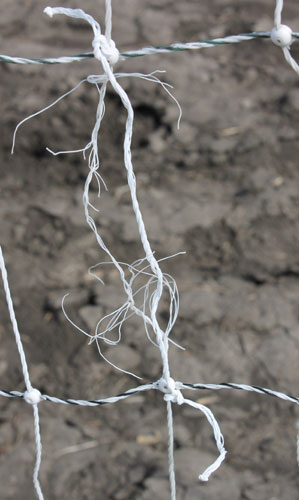
After Terry had helped me with everything he could do, I was left with the irritating job of mending the fence where those damned turkeys had pecked it last fall. Stupid turkeys. I could never stand being a fisherman and having to mend nets.
A new piece of fence tied over a damaged piece

I put wood chips in the bottom and got the feeder and waterer installed. Just after sunset, when the chickens can’t see very well, we will move them to Coop 2 for the night. They need to start out in the coop so they learn it is their new home. We’ll move the Home of the Chicken later. I’ve had enough for today.