Saturday, September 21, 2019

Floods and sauerkraut


I’ve said it before, but it bears repeating—I am not liking this new climate. We did go all summer without a flood. Last weekend, we got 8” of rain in 48 hours. The first 3” filled the creek. The second 5” went everywhere. The field was covered with water Saturday morning.
Shortly after Terry went outside, he called to tell me here was a dog penis mushroom growing under one of the oak tree. That’s really one of the common names for Mutinus caninus. It’s also known as a dog stinkhorn. I don’t make this stuff up.

The water receded fairly quickly. Once I started looking, I realized that the flood crested in the middle of the night. The bottom row of solar panels was covered in silt to a depth that measured to the top of my leg, just about 3 feet. The garden shed showed a waterline above the lower shelf. The wooden bench on which the row cover rested had floated out of place; the row cover was soaked. The kitchen-sized wastebasket in the corner was filled with water to the top.
Terry brought down the saw horses and some boards, and we commenced taking everything out to dry. Flood damage is profoundly demoralizing and emotionally exhausting. While this would have been a good opportunity to clean the whole shed out and organize it, it was all I could do to find the mates to each of about a dozen pairs of gloves. One might think the gloves would live happily in pairs. I feel like I usually take them off and put them together on the shelf, but the evidence did not support this. Sure, two or three pairs were together, but it took some looking to find the right and left of all the gloves. I took them in the house and put them in the washer.
Terry swept out the shed. We didn’t have to hose it down because it wasn’t very muddy. Upon reflection, I thought that this might be because this flood happened when the crops of the fields around us were full grown. When we had floods earlier in the summer, the crops were not big enough to prevent the top soil from washing away.
When we were done with the shed, I walked down to the creek. Terry had walked into one of his nurseries earlier in the day. While we were cleaning the shed, he told me that he had sunk in the mud to the top of his Wellies. When he tried to extract his feet, he landed on his butt. He instinctively put his hands down to lift himself up and went in to his elbows. He didn’t explain how he got himself out, but I found the prints in the ground, sort of like the lower half of a snow angel done in mud.
The imprint of Terry's legs in the mud

The flood had knocked over a deer fence.
Flood damage on the deer fence

I saw a yellow composite flower that I didn’t recognize. The composite (or daisy) family is huge, which makes species identification a challenge. The best I can do is that it is some kind of bur marigold, a.k.a. sticktight.
Putative bur marigold, covered in mud

There was an odd patch of smooth stones on the bank above the creek. Floods usually leave behind sandy silt. These rocks seemed too high to have been deposited by the flood. Perhaps the stones had once been the creek bottom. The recent flood, then, had merely washed the silt off the top of the rocks. Very weird.
A patch of smooth stones amidst the sandy silt

Detail of the stones
The only obvious survivor of my woodland garden is Joe Pyeweed. I must clean out all the weeds before next spring in case some of the other perennials survived my neglect.
Joe Pyeweed, the apparent lone survivor of my woodland garden

Sunday morning, the turkey hen came around with her poults. They still didn’t get near, but the light was better. I got a photo that was clear enough to count 5 younguns.
Turkey hen with 5 poults--there are two close together in the front, as evidenced by the two tails

Sunday was sauerkraut day. Hilda asked me if we needed to buy sauerkraut. I gave her an emphatic no. We only had 5 cabbages, but they were huge. I estimated an average of 5 pounds each. Plus we still had a good deal of sauerkraut left from last year.
Pat, Nancy, and Jane came out to help. This was Jane’s first sauerkraut experience. Hilda was running behind with her preparations for dinner and had to excuse herself. We took our usual positions, with Nancy cleaning the cabbage.
Nancy cleans the cabbage

Me slicing the cabbage.
I sliced the cabbage, wearing a protective glove

And Pat weighing, salting, and packing the cabbage in the crocks.
Pat weighs the cabbage

I assigned Jane to take pictures and count how many half-pound increments Pat put into the large bowl. Each 2.5 pounds of cabbage got 1/8 cup of salt.
At the end of the day, our crock had 20 pounds of cabbage, and Pat and Nancy went home with 10. The cabbages weighed, on average, 6 pounds, and that doesn’t include the cores and outer leaves that we put in the compost bin.
In honor of Pat’s birthday as well as raspberry season, I made a raspberry pie.
Raspberry pie

Here’s the birthday girl enjoying her dessert.
Pat with her birthday pie

By the next day, the sauerkraut was bubbling nicely.
Sauerkraut fermenting

We’re in for another heavy rain tonight. We took the precaution of moving the storage bin that we keep the chicken food and wood chips in to higher ground outside the orchard. I checked to be sure that everything in the garden shed was well off the floor.
Terry picked all the pumpkins and squash that were ready. He didn’t want them submerged again.
I picked all the red and yellow bell peppers and poblano peppers yesterday. I started two chimneys full of charcoals to roast them. It was not enough. I did the poblanos first.
Poblanos on the grill

And then the red and yellow bell peppers.
Sweet peppers next

Conventional wisdom suggests that when the pepper skin is well-blackened, one should put the pepper in a paper bag to steam. Over the years, I have discovered that a stock pot works just as well. It holds a lot of peppers and is reusable.
About 40 minutes into the process, the coals suddenly disappeared. The grill still seemed plenty hot. I tried moving the remaining coals together with the charcoal shovel, but only succeeded in knocking them through the grate. I got the last batch mostly done and hoped that the skins would come loose in the stock pot.
I had to put everything in the refrigerator and rush off to a meeting. I had a busy week. This morning, I tackled the task of skinning and deseeding the peppers. My, there were a lot of peppers. As I always do in these situations, I thought back to an important lesson of dissertation research: as long as there are a finite number of things, if you do one at a time, you can finish the job.  After two hours, I was done.
All the peppers skinned, deseeded and stacked for the freezer

And then I had to take a nap.


Thursday, September 12, 2019

Seasonal abundance


The harvest is reaching a crescendo. We dug the potatoes and pulled the onions ahead of a week of rain. We got three inches last night and woke to a flooded field. At 3:00 a.m, I saw water standing in the south garden as well, but that had drained away by the time we got up. A great blue heron stalked back and forth through the water much of the morning. I can’t imagine what it was hunting. Toads? Worms? Mice and voles swimming for their lives?
Great blue heron looking for God knows what in the flooded field

In the natural world, the acorn drop is an opportunity for many animals to fatten up before winter. The three tom turkeys make the rounds every morning, looking for all the world like the hunchbacked old men drinking their coffee at McDonald’s.
Tom turkeys looking like grumpy old men. Hrumph, Hrumph.

The turkey hens with the poults are more wary (or weary, as my students wrote). They never come close enough for a good picture. Here are some bad pictures when they were on the north side of the farm, heading for the road.
Turkey hen with poults oh, so far away

Watch out for the car! Move away from the road!
One morning they were under the fifth oak.
Hens with poults a little closer

A doe brought her twin fawns to the fifth oak to enjoy the acorn bounty.
A doe keeps watch while her twin fawns forage for acorns

My dad had raised beds on the deck and by the garage for his flowers. Now that he’s gone, we have taken over the space with strawberries. Some bear fruit only in June; others are “ever bearing.” We left them alone for the first 6 weeks to let their roots develop. Yields are not high, but there’s  enough for an occasional breakfast. Hopefully we can make jam next year.
Entire strawberry harvest on a good day

We had our appointment with the butcher last Wednesday. The meat chickens were 12 weeks old. The catalog said that’s when they were ready to be butchered. They looked huge and took up most of the space in the coop.
Big Red Broilers at the outdoor feeder

It's getting crowded in the coop
Even though the Big Red Broiler meat chickens take twice as long to get to “market size,” I am willing to raise them again. They are so much healthier than the Cornish x Rock, which just waddle to the food on legs that will barely support their weight and otherwise lie around in their own poop. The Big Red Broilers, while huge, run around behaving like normal chickens. It is very hard to get a good video of a rooster crowing when any one of a number of roosters could be next. I tried to get a chicken fight as well. This video is the best I could do. You can see roosters with their neck feathers ruffled, running while flapping their wings.
We paid a higher price for all-male meat chickens as well as for all female laying hens. Males grow faster, making them more valuable for meat. The premium on female laying hens should need no explanation. As long as we’ve been ordering from Murray McMurray, we’ve gotten the sexes that we ordered. Note, however, that we got “straight run” (males and females) Cornish x Rock meat chickens in previous years. Sexing chicks is notoriously difficult, so it was only a matter of time before we got something that we hadn’t ordered. As luck would have it, this year it happened twice. We had one female meat chicken.
Male Big Red Broiler in front; female in back

And one Whiting True Green rooster. We had our suspicions when he grew a larger comb, wattle, and tail feathers than the hens. Still, he didn’t crow, so we couldn’t be sure. Meanwhile, Bianca continued to be sullen and withdrawn. We put her back in the little red barn and gave her vitamins in buttermilk every afternoon. She liked the treats, but did not seem to improve in her disposition.
We had to take the food away from the meat chickens and the hens we were rotating out 24 hours before taking them to the butcher. Instead of depriving everyone, my thought was that we could move the pullets to the orchard and the old hens to Coop 1 Monday night. We would have Tuesday to be sure we had everyone in the right spot.
Tuesday morning, Hilda opened the coop and let Bianca out of the little red barn. The suspected Whiting True Green rooster jumped her immediately, pinning her down and having his way with her. This settled the question of gender. Hilda grabbed him and put him in the little red barn with no food. He was going to the butcher too.
Poor Bianca. She lay on the ground listlessly. Hilda thought she was dead. She picked her up gently and put her in a nest box, fully expecting to find her stiff later. Later in the morning, however, I looked out my kitchen window and saw Bianca running around the orchard.
In Coop 1, the old hens were up on the perch to keep from getting jumped by the roosters. We had to deliver the chickens between 6:00 and 7:30 Wednesday morning. We were up long before the crack of dawn to load them into cages. We put the hens in a separate cage for fear that the lusty roosters would kill them before we got to the butcher. Terry watched the door on the cage. Hilda opened and closed the coop door. I did the transport. The only mishap we had was when I blinded Terry with my headlamp, and a rooster jumped to the ground. I grabbed his leg before he could get far.
The next day, we went to pick them up at the crack of dawn. Despite our fears that we would end up with behemoth chickens, the dressed weight was between 5 and 6 pounds. Perfect.
Freezer heaven

It is the time of year when nearly every flat surface in the house has a tray full of tomatoes on it. There was a day when I planned to bake tomatoes for pasta sauce, but I also needed to use up the rest of the zucchini and pattypans in a batch of roasted ratatouille. Before starting my kitchen work, I planned to spend 30 minutes pulling out the pea plants and taking down the trellis.
As soon as I got to the garden, I saw that the Scarlet Beauty beans had not only reached maturity and dried, but also collapsed to the ground and started to rot. Dammit. I picked the beans and pulled the plants. With the beans picked, I had to put the drying screens in the greenhouse to dry the beans. But the screens were full of dust, mouse droppings, and even bird poop. Must have had a bird in the storage shed. So I propped up all the screens on the side of the greenhouse and turned the hose to “jet.” I pulled the peas and rolled up the trellis while the screens dried and then spread the pods on a screen inside the greenhouse.
That all took two hours. Time for lunch. After lunch, I got the ratatouille in the oven. Next task: pick melons. I love cantaloupe, and they are at their best when they stay in the garden until the vine comes loose. Which happens pretty much all at once. I took a wheelbarrow down and filled it with 17 cantaloupe and a dozen or so Golden Midget watermelons. I scrubbed off the mud and rind-invading picnic beetles outside and set them on the patio chairs to dry. Hoo-boy! Where will I put 30 melons? In the process of rearranging the overflow refrigerator to make room, a wine bottle fell out of the door and shattered into one million pieces. Because I didn’t have enough to do already.
I had most of the wine blotted up and was starting to pick up the larger pieces of glass when Terry came in. “Let’s not put wine in the refrigerator door anymore, okay?” I said.
Terry offered to finish the clean up so I could take care of the ratatouille and fix dinner. What a day. I did not get to the baked tomatoes. That’s the good thing about retirement—there’s always tomorrow.
After two batches of baked tomatoes, I made tomato confit. Like the more familiar (or not) duck confit, tomato confit involves slow roasting in lipids--duck fat for duck confit, olive oil for tomato confit. It takes hours. Two half-sheet pans of tomatoes reduces to about 2.5 cups of intensely tomatoey goodness.
Tomato confit before slow roasting

2.5 cups of tomato confit ready for the freezer
I was able to find good homes for many of the cantaloupe. The Golden Midget watermelons were an experiment. It’s an heirloom variety that I ordered from the Seed Savers Exchange because it was supposed to mature in (if I remember correctly) 90 days and, as a bonus, changed from green to yellow when ripe. It did, in fact, get mature and turn yellow within our growing season, but it just wasn’t as sweet as I would have like a watermelon to be. Since I was disappointed in the quality, I chose not to give many of them away. 
Golden midget watermelons. Cute, but not very sweet
What does one do with too many not-very-good watermelons?I first had watermelon juice in Belize, and I can’t think of a more refreshing beverage. I got out my tomato press and put some watermelon through it. The juice tasted sweeter than the melon! I took the rind of the rest of the melon and made six quarts of juice. I put it in the refrigerator overnight to chill thoroughly before I put it in the freezer. The following day, I learned that watermelon juice is highly perishable. It had developed off flavors which were not improved by the addition of rum. (A good scientist explores all possible solutions.) The watermelon juice went to the compost bin. Living and learning, as Manolo (a fellow graduate student) used to say.
Juice comes out the front, seeds spit out of the chute on the side.

Sunday, September 8, 2019

The Sandwich Fair


Last Thursday, we all went to the Sandwich Fair. The Sandwich Fair has nothing to do with sandwiches. It is, in fact, the DeKalb County Fair, which is held in Sandwich, IL. The first fair was in 1888. At the time, Sandwich was an up-and-coming town. The Sandwich Manufacturing Company made agricultural implements that were shipped internationally. In the present day, if Sandwich isn’t the end of the Earth, you can see it from there. Because the region is still primarily agricultural, and the original purpose of a county fair was to show of agricultural products, the Sandwich Fair has stayed true to its mission.
Jane proposed the trip because Fay’s Barbeque was going to be there. Fay’s used to do all sorts of fundraisers but has cut back in recent years. The Sandwich Fair is one of the last events they go to. I needed to get my annual corndog. We skipped the McHenry County Fair due to insufferably hot weather. We picked Thursday to go because it was Senior Day, and everyone over 55 got in for $6 instead of the usual $10 for adults. My first senior discount!
On the drive down, Jane said she’d never had a corndog.
“How can you use those words together in a sentence?” I asked. Never had a corndog? Seriously?
I was starving by the time we got to the fair, but we passed several corndog vendors before selecting one. You have to be particular about where you get your corndog. A corndog absolutely much be dipped and fried on site. Watch out for the vendors who get their corndogs premade from a freezer. Finally, I saw some naked hotdogs on sticks behind one of the counters. The problem was that they only made foot-long corndogs. Well. Quality was more important than quantity. Terry got an Italian sausage sandwich. Hilda, Jane, and I got corndogs. They were delicious, but way too much. I had to throw away the last bit, and still I should have stopped sooner.
Hilda and I with our corndogs

Terry went off on his own after that. The rest of us headed to the Home Arts building to see a culinary competition. Just outside Home Arts, a mariachi band was playing. I love a mariachi band. They played a familiar melody, and one of the band members gestured to encourage us to sing along. I looked behind me and saw that there were some people in the audience who knew the Spanish lyrics and were singing. I did not join in. The only lyrics I knew were “Aye, yi, yi, yi, I am the Frito Bandito,” and that seemed culturally insensitive.
Mariachi band

The official Sandwich Fair souvenir stand was also by Home Arts. Jane bought a nice embroidered hat because she had forgotten to bring one.
Jane's new hat

This food stand was also near Home Arts. I thought I’d seen every possible food on a stick at the Minnesota State Fair a few years back, but this was a new one. Cookie dough on a stick has zero appeal to me. Ewww.
Cookie dough on a stick? No thanks.

The Home Arts building was crammed with quilts, clothing, and crocheted items on one side, and all manner of cookies, breads, cakes, and canned goods on the other.
Quilts and clothing in the Home Arts building

The culinary competition judging was going on at the stage around back. The judges were tasting briskets. It was very boring, but after one woman stopped yapping, another woman played the hammered dulcimer. We sat down to listen for a while.
We wanted to see the poultry and went there next. We marveled at how big some of the roosters were as well as how small the bantams were. Two bantams were for sale, $10 each. Hilda wanted to buy them because they were so cute. I didn’t think she should. The other chickens would probably harass them, and besides, did she want to carry them on her lap on the way home?
In addition to the corndog, Hilda had her heart set on a bucket of French fries. We found a vendor with boxes of Idaho potatoes behind the stand. When she saw what was available, she wanted the bacon cheese fries. I should have warned her. She thought the fries would be covered with grated Vermont cheddar and topped with recognizable pieces of bacon. In fact, the fries were covered with Cheez Whiz, and not even genuine Cheez Whiz, but a cheap imitation. I thought the bacon bits were some kind of meat product rather than salt-and-soybean Bacos, but it sure wasn’t Nueske’s. Did we eat them anyway? Yes, we did. The fries had good potato flavor.
Hilda and her bacon cheese fries

We met our friend Jan and her sister, Pat. They grew up in Somonauk, about 3 miles from Sandwich. Pat still lives there; Jan had driven down from Chicago. We sat in the shade for a bit to catch up. One of the best things about the Sandwich Fair is the mature trees on the fairgrounds. The good people of Sandwich protect the trees by putting lawns and benches around them as “Shaded Rest Areas.” Foot traffic does not compact the soil like cars do.
Jan and Pat’s family uses the fairgrounds for family reunions. “It’s amazing,” Jan told us. “This place looks so small when it’s empty but so big when the fair is here.”
According to the Sandwich Fair website, the fairgrounds is only 20 acres, which is smaller than our farm.
We went together to the Sandwich Fair History Museum, which was located on the fairgrounds in a building from 1892 that originally housed the Secretary’s Office. Jan explained that every year, souvenir items, such as coffee cups, were sold at the fair. Many of these items were on display. Several of her cousins served on various Fair committees over the years.
Our next stop was the train. “You should go,” Jan said. “It’s famous.”
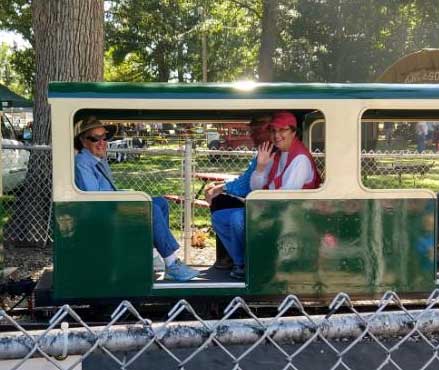
While Hilda and I were looking for the ticket booth, we met Terry. The three of us rode the train together.
Hilda and Terry on the train

Jane's picture of us on the train
The train is a one-quarter scale replica of a “Class S-4 Hudson Type 4-6-4 Burlington Series 3000 engine” built by Augie Otto in Sandwich. The train debuted at the 1974 Sandwich Fair. “Both Bell and Whistle Tones are Authentic,” it said on the sign.
The train engine

We went to the the Antique Farm Equipment and Antique Trucks and Tractors displays next. One of the more fascinating pieces of equipment was a machine hooked to a two-man lumber saw. It was working when I first walked up, but it broke down before I could get a picture.
This display shows ice cream scoops from 1878 through the present.
Ice cream scoops through time

Terry liked this antique truck.
Antique truck

Jane took this picture of Jan’s grandfather’s tractor.
Jan's grandfather's tractor

We got four Fay’s dinners to go at the end of our day at the fair. There was enough food for two days in there. I also bought two bags of mini-donuts on the way out. Our fair food was complete.

Wednesday, September 4, 2019

Pollinators and pollination


Plant flowers, and the pollinators will come. I wish I had more time to watch them. I mentioned in a previous post that I had seen a silver spotted skipper for the first time. We have lots of them. I got a picture (well, lots of pictures, but autofocus often let me down) of one on the obedient plant in the wetland restoration.
Silver-spotted skipper

Also on the obedient plant, I saw a painted lady
Painted lady

And what I think is some kind of copper, but it is impossible to identify when it is all folded up with its head deep in the floral tube. Who knew there were so many?
Quite possibly some kind of copper

My life will be complete if I ever see a hummingbird at my cardinal flowers. We took a giant step away from that goal because the wet spring allowed reed canary grass to proliferate to such and extent that I could only find three cardinal flowers, and one of them was across the firebreak from the restoration area. It’s good to know that they are able to colonize other areas. If next spring is not so wet, I hope to mount an aggressive attack on the reed canary grass (or RCG, as it is called in restoration circles).
Cardinal flower--my favorite. So red!

I have learned some things about corn pollination this year. We did not cover the seeds with row cover, and many of the seeds suffered predation. Terry replanted. This resulted in a sparse crop that bloomed at disparate times. Early in my corn growing experience, I tried growing four rows of corn, which was not enough. I ended up with cobs that only had a few large, round kernels. I was so worried about pollen limitation on this year’s crop that I hand pollinated the first row as the silks and tassels appeared. Those ears were great. I went on vacation; one thing led to another, and I never got around to pollinating the rest of the rows. It turned out that they did pretty well on their own. 
The corn that was left after two weeks of eating it nearly every day
Here’s the first thing you need to know about corn pollination: ever kernel is attached to a silk. The pollen grain has to travel all the way down the silk to fertilize each kernel. If you look closely, you can see a “silk scar” on the kernel where the silk attached. The “cob scar” is on the other side, where the kernel attaches to the cob.
I always knew that the corn at the tip of the cob was less developed than at the base. This year for the first time, I realized it is because pollination goes from bottom to top. The silks start out short and continue to grow for many days. My guess is that the earliest silks are attached to the bottom kernels. If there’s lots of pollen around, you get nice, even rows of uniformly-sized kernels (left in the picture below).
Left: good pollination throughout; middle: uneven rows show limited pollen, no pollination at the tip; right: good pollination at the bottom, sparse pollination toward the top.

If pollen is limited, the pollinated kernels grow over the unpollinated kernels, as can be seen in the irregular rows at the bottom of the cob in the middle. On this cob and many others, the pollen just ran out after a certain time; all of the kernels at the top are unpollinated.
The cob at the right shows a few round kernels that got pollinated among a lot of duds before the pollen became completely unavailable for the last kernels.  The base is well-pollinated as with the other cobs.
More than you wanted to know? Perhaps, but I can’t help myself. I don’t have students to torment any more.
As long as we’re talking corn, here’s a picture of one of my favorite summer suppers. You may note that the BLT does not have any L. The BLT has an inherent seasonal disconnect, at least in my world. The L is long gone before the Ts ripen. Bacon is forever! Also On the side is a bowl of cucumbers in sour cream. Heaven.
Farm to table supper: bacon and tomato sandwich, corn on the cob, cucumbers in sour cream


Thursday, August 29, 2019

Vacation, Days 5 and 6: Chik-Wauk and Custard


Thursday, August 15
We had a leisurely morning beginning with blueberry pancakes, peaches, and bacon. After breakfast, we went down and fished off the dock. We didn’t get anything, which was okay. It was a pleasant day to sit in the sun. Jane was watching little fish nibble at her twister tail in the water just off the dock when a large snapping turtle came into view.
“Pull your hook up quick!” I said while reeling in my own line. There are few things as horrifying as hooking a turtle. I’ve done it only once, but that was more than enough. That was a mild-mannered painted turtle that was half the size of this one. And snappers are mean.
I wanted to take a picture, but by the time I had my camera out, the turtle had disappeared under the dock. I looked under there as best I could without spotting it. I concluded that it had slipped off to the side when we weren’t looking. We kept the hooks out of the water until we thought it was safe to resume. I spent my time looking at the plant life along the deck. I’d see water lilies and Engelmann’s arrowhead on previous trips. There were two small white flowers that were unfamiliar. One looked like a giant pin, and the other was tube-shaped.
Giant pin flower on the left, tube-shaped flower on right
Both had leaves in basal rosettes at the bottom of the lake with long stems to elevate the flowers above the water. One of them was easily identified as water lobelia.
Water lobelia

The other remains a mystery. Even Nancy didn’t know. It looked like the head of a pin, only larger. Up close it was rather pretty.
Mystery flower

When we went up for lunch, there was a white admiral poking at a mushroom with its proboscis. Was it after water? Food? Minerals? Only the butterfly knows.
White admiral on an old mushroom

In the afternoon, we drove down to the end of the Gunflint Trail. At the Chik-Wauk Museum and Nature Center, we discovered that they had added Watercraft Exhibit Building.
The new Watercraft Exhibit Building

The display showed the progression of boats commonly used since the area opened for tourism. There were some beautiful wooden boats, which I could only assume were pretty heavy to be portaging. I learned that Grumman, the manufacturer of the canoe we had when I was a kid, started making canoes when the conclusion of World War II put an end to the demand for airplanes. Duh! Why had I never recognized the similarity in the rivets?
The inside of the familiar Grumman canoe

Another boat I felt was picture worthy was the Folbot, which broke down into two presumably very heavy packs. The company claimed that it could be put together in 45 minutes, although the person who donated the boat remembered that it was at least two hours.
The Folbot canoe can be disassembled and put in two packs

It looked complicated. The cross pieces of the internal frame attached to the sides with wingnuts. Then somehow one would have to get the canvas stretched taut to keep the water out. I’m sure it seemed like a good idea at the time.
Inside detail of the wooden supports that attached to the sides with wing nuts

We took a drive through the Trail’s End campground. It always brings back memories for me. We were surprised that the campground was nearly full. It made us happy that so many people are still camping, including several youth groups, but it did prevent me from hopping out at Campsite 19 to look at the rapids.
We had dinner at the Red Paddle Bistro, as is our custom. They don’t have a Buddy Burger (one burger cut in half with two side orders) on the menu any more, but Lucas, our server and bartender, said that he could “make that happen.” No one needs to eat a half-pound burger. We ordered the Lodge burger with mushrooms and aioli. We got a burger with cheese, onions, and pickle. The bill said “Gunflint burger.” It was still a good burger, and we had it mostly eaten before we realized we hadn’t gotten what we ordered. Even though it was late in the season, Lucas seemed like he was new on the job.
We took a break from Marble Chase to go down to the dock at sunset. The sky was too cloudy to see the sun or for the sun to make the clouds pretty. The lake was so calm and peaceful that we weren’t disappointed.
We heard the loons laughing before we went to bed.
Friday, August 16
The morning was still and cloudy. We had the last of the eggs for breakfast. We were in the clean-out-the-refrigerator mode, which meant that meals no longer followed a cohesive theme.
Breakfast--scrambled eggs with ham, peppers, onion, and cheese curds; bacon, and English muffins

We started organizing our things to get packed for the trip home. We went up to the office to pay our bill. A drizzle turned into full-fledged rain as it was getting to be lunch time.
We went to town in the afternoon for our last stop at Sydney’s for custard. We drove out of the rain on our way. There was a new store called Yellow Bird Art Gallery. It featured a number of local artists and seemed reasonably priced. Still, I held back because I already have too much stuff.
We stopped in several other stores and bought nothing. We had our custard and went back to the cabin.
I made fajitas with the remainder of the chicken, peppers, and onion. We topped them with the last of the pico de gallo. We also finished the green beans and drank the rest of the wine. We had to eat inside because it was too wet on the deck.

We loaded as much as we could into the car so we could get on the road faster in the morning. The end of vacation is always sad, but it was nice not to have the stress of thinking about going back to work after I got home.
The sky cleared during the night. On Saturday morning, the lake mirrored not only the shore but also the nearly full moon. Goodbye, Cabin 1! Until next time….
Last view of the lake with the reflection of the moon (right of the dock)