Sunday, July 22, 2018

Boundary Waters vacation, days 1 and 2


I have just returned from my annual trip to Hungry Jack Outfitters and Cabins near Grand Marais, MN with Jane, my best friend for 30-some years.
We left Friday and drove as far as Chippewa Falls, where we met our friends Pat and Julie for dinner and Connell’s Supper Club. Julie had read about their legendary onion rings on the website and requested a half order, which turned out to be enough to feed about 15 people. It was fish fry night. Pat asked for his fish fried while Jane and Julie got broiled. I don’t like fish. I had ribs. The baked potatoes must have weighed close to two pounds. After all the onion rings, I ate two ribs and two bites of potatoes and took the rest with me in a carryout box. We’d find room in a cooler somehow.
The Art Festival was in full swing when we got to Grand Marais on Saturday afternoon. There were cars everywhere. And it was hot! We came up to get away from the heat. The forecast had been for highs in the 60’s and lows in the 50’s. I packed long underpants, for heaven’s sake.
We were lucky enough to find a parking place near Sydney’s. I got in line for the cones while Jane went around to see if our bench by the lake was available. She came back shaking her head. The bench was gone! Our bench! Gone! Sydney’s had expanded their indoor dining room and replaced our bench with an impossibly low bench across the front of the building. We walked across the street and ate at a picnic table overlooking the harbor.
Jane and I got to the cabin at 4:00. It was 84°. We worked up a sweat unloading the car. We drank big glasses of water followed by big glasses of grapefruit margarita. Jane made steak on the grill while I used the leftover baked potato from the previous night’s supper for hash browns. I peeled one of the cucumbers I’d brought from the garden and mixed it with the leftover sour cream that had come with the baked potato.
Saturday supper: grilled steak, hash browns, cucumbers in sour cream

The next morning, I made blueberry pancakes with peaches on top.
Sunday breakfast: blueberry pancakes with peaches, maple syrup, and bacon

Thinking that it might be hot later in the day, I made peach and blueberry cobbler with the cream scones I’d brought.
Peach and blueberry cobbler
After breakfast, we got our fishing licenses (now $44, up from $39 last year)
I put leeches on our hooks and immediately got a perch. It swallowed the hook. I hate that. I couldn’t get the hook out, so I handed it over to Jane. She managed to free the fish, and it swam away sideways. Still, not an immediate kill.
It’s bad to have the first fish swallow the hook. It leaves me rattled and less than enthusiastic about fishing. But it was the first fish, and it didn’t seem right to quit. Soon we both lost our leeches. Jane switched to a twister tail. I put on another leech, which I quickly lost. After the fish incident, the leeches were creeping me out more than usual. I don’t ever catch anything on a twister tail, but then I wasn’t that keen on catching anything. Jane was getting lots of strikes on her line, so I too put on a twister tail. I got strikes, but no fish on the line.
“I think maybe the tail is blocking my hook,” I observed.
“You are supposed to move it up so it catches on the barb on the jighead,” Jane answered. “It’s supposed to keep the tail from falling off.”
I took a good look at the jighead, and by God, there was a little barb on it. If I had noticed it before, I had assumed it was an unintentional and functionless artifact of manufacture. “Why didn’t you ever tell me this before?” I asked. Jane was the person who first introduced me to twister tails.
Twister tails on jigheads: Top, right; bottom, wrong
“I thought you knew. Aren’t there directions on the package?”
“’I thought you knew,’” I said mockingly. “I learned to fish with bare hooks and worms. How would I know?”
“I’m sorry I held back on you all these years.”
Dang--there are directions on the package. Note: NOT FOR HUMAN CONSUMPTION
Well. With the tail correctly positioned, I caught a good-sized bass. “Take a picture!” I told Jane. “It might be the best fish we catch all week.”
Not-so-bad bass
I followed that up with another little perch.
Small perch
And a very tiny perch that was hooked from the outside of its lower lip in. I’m not sure how that happened.
Ridiculously tiny perch that was hooked from the outside in
Jane continued to land nothing. We fished until noon and then went up for lunch.
That was it for excitement/activity for the day We took showers and hung out on the deck enjoying the cool breeze. It was, thankfully, much more pleasant than the day before. We opened a bottle of wine. I made steak quesadillas for supper.
Steak quesadilla on the smaller plates
We played games after dinner, forcing ourselves to stay awake until 8:45. My, we are getting old.

Thursday, July 12, 2018

Goodnight, girls


One of the best things about having chickens is that it forces me to be outside during the most beautiful times of the day. One might think that the sheer glory of early morning and late evening would be enough motivation, yet unless it is my morning for chicken chores, I tend to linger in bed. When the hens are in summer pasture, I am responsible for shutting the coop. I do the chicks too, as long as I have to put shoes on anyway.
I have been trying to get the most out of my summer break by going out at 8:00 to sit on the patio, listen to the birds, and breathe deeply. It worked out well until the mosquitoes got bad. I watched the sky change colors. Often clouds to the south and east were more brilliantly colored in pink, gray, and orange than the clouds in the northwest. Sometimes as the temperature goes down, there is a point when the air smells wet and earthy. The dew point, perhaps? A thermal inversion? I don’t know why. Whatever the reason, it’s wonderful when the lilacs are blooming because their fragrance permeates everywhere.
I learned something about the hens. They squabble about where to sit on the perch every single night. Most of them will go in, and then I will hear squawking and thumping. Suddenly one or more chickens will burst out of the coop like a cowboy through the swinging doors during a saloon fight. Those who have been expelled shake it off and return, chastened, to take (I assume) a lower position. I don’t know what position that is. The perch is level. One side is away from the door and has the ladder, and the other side in behind the door with no ladder.  The final order when I close the door is different every night, although I notice that the Barred Rocks tend to sit on the door side.
The hens are usually ready for bed about 8:30. At first, I thought that the chicks would be ready then also. They are much more agreeable about going into the coop on a cool night, and those have been few and far between this summer. One evening, all were in but three meat chickens. I stood by the fence waiting for them to go in. Two chicks came out to get a drink from the waterer. Two others went in. Three came out for a drink. And so it went until I tired of it and took the waterer away. Eventually, I went in the run and shooed them toward the door. I’ve learned to wait until nearly 9:00. By then, the fireflies are coming out. I love the fireflies.
Now that the mosquitoes have hatched, I wear my mosquito net hat, long sleeves, and long pants. I can’t sit down because that holds the clothes next to my body, allowing the mosquitoes access to my skin. As long as I stand, there’s enough airspace between the clothing and my person that the bugs can’t bite me. I walk around and look at the garden, the raised beds, the potatoes. Such a peaceful time of night.
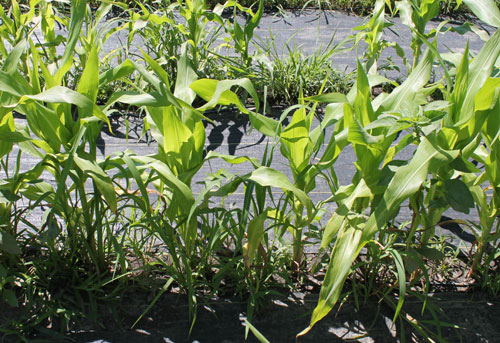
We had cooler weather last Friday and Saturday. Hilda and I worked our tails off weeding the potatoes and corn. I had corn on my list of things to do, but the potatoes ended up being the emergency. They were so overrun with crabgrasses that their growth was stunted. The corn, on the other hand, was holding its own, towering over the weeds. I wondered why, but only for a moment. Corn and crabgrass are both C4 plants. They have a pathway that allows them to fix CO2 into a 4-carbon compound in addition to the usual photosynthetic pathway that has its first stable intermediate as a 3-carbon compound. To make a very long story extremely short, C4 plants grow better than C3 plants in dry hot weather because they can us the C4 compounds for carbon to continue photosynthesis even after the stomata (tiny holes in the plant leaf) start to close.
Corn towering over the crabgrass
Bianca seems perky enough, but her feathers are downier than the other True Blues. Here’s a picture of her with two of the Dominiques. They still have persistent down on their heads.
Bianca is still small and downy
While I was taking pictures Madeline got a little panicky. After furiously flapping her wings, she got up as far as the windbreak. Once there, she seemed puzzled by this peculiar turn of events. Where am I??
Madeline flies to the top of the windbreak. What is going on?

Four tom turkeys have been hanging around. With the breeding season over, they seem to have not much to do but lounge in the shade of the fifth oak. They remind me of the old men who hang out at McDonalds every morning, drinking $1 cups of coffee and kibitzing.
Four tom turkeys, one lying very flat, lounging beneath the fifth oak
There is one other thing the turkeys enjoy, and that is dust bathing in the pumpkin patch. If Terry spots them through the kitchen window, he runs out yelling and waving his arms. The pumpkins got as weeding as everything else, of course, so Terry went at them with the small rototiller. I expect the turkeys figured he was making better dust beds for them.
Terry graciously making dust baths for the turkeys
Indeed, we chase them out frequently. I couldn’t catch them in the act because they saw me coming. Here they are making a retreat. One day last week Terry was mowing with the big tractor. When he saw the turkeys heading for the garden, he drove the tractor around to chase them off.
Turkeys leaving the garden

I was so proud of us when the corn and potatoes were weed free. It didn’t take long to notice that the onions needed weeding again. It never ends.
Except for the peas. With a heavy heart, I took down my lovely pea trellis yesterday. The peas failed epically. The fence came down, and Hilda got the weeds out of the row. So sad. Not one single pea this year. Sniff.
I’m discouraged about the beans as well. They looked like they were coming around in the pictures I took for my last post. The leaves, however, seem stunted. Perhaps I am checking them too often. I will be leaving for Minnesota with Jane tomorrow. I’m hoping everything (excluding the peas) will look better when I return.

Wednesday, July 11, 2018

Lightning strike


On Sunday, July 1, I went upstairs in the afternoon to compress some photos in preparation for my weekly blog post. I couldn’t do anything outside because it was a) beastly hot and b) about to rain. Mom, Dad, and I were all in our respective rooms doing one thing or another on our computers at the time. I got as far as deciding which photos to use and moving them to a file on my desktop computer when lightning struck the oak tree next to the house. FLASH/BOOM. The light and sound happened at the same moment. I heard the thunder more in my bones than my ears. The tree exploded, throwing bark, leaves, and small branches everywhere. Steam (smoke?) rose from the ground at the base of the trunk.
I had grown cavalier about using my computer during thunderstorms, but I can tell you that all of us had our computers off and unplugged right quick after that.
The storm passed. Terry and I went out to inspect the damage. The lightning had gone down one branch, which looked split open.
The branch that the lightning struck

A good chunk of bark was missing from the trunk. Terry was unconcerned. He’d seen many trees struck by lightning that survived for years afterwards. “It’s 17% girdled,” he said, surveying the amount of bark missing from the trunk. “It will be fine.”
Missing bark from the trunk

17%. Not 15, not 20. He’s so quantitative. Debris was all over the place. When I expressed amazement at the magnitude of the spread, Terry told me that when he lived in North Dakota, lightning struck a cottonwood tree and sent a piece of bark all the way through a trailer house, in one side and out the other.
Terry went out right away to take a big pieces of bark out of the road. “Don’t want anyone to sue us over a flat tire,” he said. It seemed to me that a normal person would have just driven around it, but you never know. In this picture, note the piece of bark sticking straight up on the left side of the trunk. The bark was at least two inches thick, which accounts for the fact that bur oaks can survive prairie fires.
Debris scattered all over the yard

The next day, we went out to clean up the yard so I could mow. Here’s what we ended up with.
Muck buckets full of bark and branches

And here’s the post that I was going to do last week:
The garden seems to be recovering slowly. The beans at the north end kept some of their leaves after the flood. This picture shows new growth above the silt-covered leaves.
New leaves above silt-covered leaves

Many of the beans dropped all their leaves after being submerged. My assumption that the buds had survived proved correct in many cases, as shown here.
New growth from completely defoliated beans

The zucchini also had fresh green leaves above the dusty ones.
The surviving zucchini looks pretty good

The cabbage plants that I bought at Klein’s seemed to double in size overnight.
New cabbage plant

The cabbages that I so hoped had survived did not. My guess is that a few of the roots survived the flood but the rapid onset of hot, dry, windy weather took more water out of the leaves than the roots could provide. There was no opportunity for the roots to recover.
A cabbage that initially survived the flood died in the hot, dry weather afterwards

Hilda noticed that a raccoon with wet feet had taken a stroll down the landscape cloth.
Raccoon prints on the landscape cloth

The meat chickens are getting more comfortable with being outside, although they tend to stay in the coop during the heat of the day. We have a fan in there. In the cool of the evening, however, they lounge about on the lawn.
Chicks lounging on the lawn in the cool of the evening

We take the food away at night, as I have mentioned many times, so that the meat chickens will not outgrow their legs and become lame. That results in a feeding frenzy in the morning.
The morning feeding frenzy

In this video, you can see that two Whiting True Blue chicks work their way to the feed by slipping between the monstrous meat chickens and walking on top of the feed. On this particular day, four of the pullets chose to not even join the fray. They will eat after the meat chickens settle down.

Tuesday, July 3, 2018

Technical glitch

There will be no post this week as our phone/internet connection was knocked out by a lightning strike near the house (not TO the house). We are all fine. Repairs are scheduled July 9.

Wednesday, June 27, 2018

Here we go again


We started digging garlic Friday, beginning at the south end. It was nasty, mucky work. I loosened the bulbs with a pitchfork and tossed them to the grass, where Hilda cut off the roots and associated clump of mud. Shaking the roots free of the soil was out of the question. About 2/3 of the way to the north, the soil seemed dry enough that rotting was not imminent. We stopped. I was spent, and we still had to hose them off and hang them up.
I mentioned earlier that I was feeling pretty low Saturday morning. We’d been cleaning up wet, muddy messes for days while we waited to see what would and would not survive in the garden. I went out to do my chicken chores at 6:00. I noticed that the brown box was still wet and had some nasty looking stuff in the bottom. I took everything out with the intention of giving it a good rinse. It seemed like an easy enough task, but it was complicated by the fact that the lid is attached and does not open all the way. So when it came time to flip it over to drain it, I had a problem. I pulled over a little patio table to elevate the box so the lid would be out of the way when I turned it over. I didn’t think to close the box before lifting it, and in the process the lid fell on my face, knocking my glasses off my nose.
When my mother reads this, she will think, “Why didn’t you ask me to help?”
And I will respond right here, “I didn’t know the lid was going to fall on my face, did I?”
Fortunately, there was neither blood nor bruising. It did nothing for my crappy mood however. I cried a little when I told Jane about my morning, my garden, my miserable, sucky, mud-filled life. Good friend that she is, she only laughed briefly when I told her about dropping the lid on my face.
The Bee Blitz was a good diversion. I felt perkier by the afternoon.
It was dry enough Monday that I got out for a good assessment of the damage. Hilda helped me pull off the row cover and roll it up. The should-haves don’t count, but I should have done it right away. It might have helped it dry out. The news was not good. Here is a picture showing the green north side of the garden fading to the brown south side. In my infinite wisdom, I planted three pattypan squash on the north and the zucchini to the south. The pattypans look great. The first of five zucchinis looks okay. The second is severely stunted.
Summer squash, left, with healthy pattypans and struggling zucchini. Beans, right.

The last three are not just merely dead, but really most sincerely dead. Note that the amaranth looks just fine.
Former zucchini with dried, mud-covered leaves splayed out in all directions.

Take a guess: of zucchini and pattypan, which variety of summer squash does Terry love, and which one will he not even try?
The beans suffered a similar fate, although the survival of the north end is more tenuous. These are the beans at the south end.
Drowned beans

The cantaloupe looked amazing! Even the ones that had been underwater for a day looked fine. Who knew they were so robust?
Cantaloupe resilence

Same story with the tomatoes. The north tomatoes were recovering their turgor.
Tomato (and eggplant in back) on the north side

To the south, we had lost 12 to 14 of the 36.
Tomato on the south side

We finished harvesting the garlic on Monday. Here is Hilda cutting away the mud. As you can see by the ones on the ground, the clumps were still considerable.
Hilda cuts mud away from garlic roots

The cleaned garlic went in a muck bucket for transport.
Big bucket o'garlic

And here it all is, washed, bundled, and hung to dry. At least we have garlic.
Garlic hanging to dry

I worked in the garden pulling weeds and trimming the dead leaves off the beans. I only got through the north half of two rows. I thought maybe they might pull through. It seemed like the buds were still viable.
I gave up on the beans to see what was going on with the coles. We had some pretty good looking cabbages, but about half were dead. There were more Brussels sprouts among the weeds than I thought at first glance. We had direct seeded some of them, and I thinned them down to one. I wished that I could have transplanted the extra, but I know better. I’ve done that experiment before
While I was pulling weeds, Hilda was seeking out replacements for the dead tomatoes. She came home with these, which are leggy, but alive.
Replacement tomatoes

Somehow, optimism returned. We've lost 30 or so days of the growing season. If we have a late fall...I started soaking beans Monday night to sprout on paper towels for planting as soon as I could get the rows cleaned up. Tuesday found me going through the leftover plants at Klein’s like a sailor on shore leave. I bought two kinds of cabbage (6 each), 3 kale, and 4 zucchini plants. I also found some fennel that purported to be good for seed. Seed fennel is hard to find, as it seems most people grow it for the bulb.
Replacement cabbages and kale

I got home in the afternoon just before we got 2.8” of rain in 2.5 hours with the ground still saturated and the creek barely contained in its banks. Another flood. Not as bad, but demoralizing, nevertheless. I just kept telling myself that we wouldn’t lose anything that wasn’t already dead. When I said that to Hilda, she responded, “Are you sure? Have you seen the garden?”
“Fine,” I said, “you worry about that and see how much good it does.”
Luckily, she laughed rather than being offended. We were all a bit testy last night.
View to the west

The garden underwater again
We had another downpour a few hours later, bringing the total rainfall to 3.4”.
Rain gauge at 8:15 p.m.

There was more wind with this one. One of Terry’s pear trees split and fell over. He said it had a bad trunk to begin with, and he was going to replace it anyway.
Pear tree with split trunk
And we’ve gotten better with practice. I watched the water level closely. Terry and I put on our Wellies and moved everything off the floor of the garden shed when the water was just up to the threshold. We took the brown box out of the chicken run as a precaution.

View to the south. Note water right to the bottom of the shed door.

Now we wait again for the ground to dry and the plants to recover or pack it in. And all the while, I can only think of the immortal words of my late Uncle Carl, who always knew what to say in a crisis: “Well, God damn.”


Bee Blitz


I participated in my first Bee Blitz on Saturday. I got the invitation from a former student of mine, Cindi, who is now a wildlife ecologist for the McHenry County Conservation District. While I cannot claim a large role in her success, my class was one of the first she took when she decided to go back to college and change careers. I feel a great deal of undeserved pride that she has done well. I am impressed that she was able to land a job in wildlife ecology without relocating.

I’m not sure when Bee Blitzes began. Colony collapse disorder has increased awareness of bees in the last 10 years or so. Bee Blitz is a citizen science program to get volunteers out to photograph bees. The University of Illinois has a Bee Spotter website (beespotter.org) where anyone can submit bee photos for identification. U of I then assembles all the data for bumblebees and honey bees in the state, which is also publically available. It’s a great idea because the volunteers don’t need to know anything about bees. The experts in Champaign-Urbana take care of all the hard stuff.

The Bee Blitz volunteers assembled at the Visitor Center. Promptly at noon, Cindi broke us up into four groups to visit different areas. She explained the degrees of difficulty of the different hikes. Cindi led the group with the easiest walking. I picked that one, even though I would have deferred to anyone who was more feeble. Most of the volunteers were younger than I was, but even those that were older volunteered for the most vigorous hike, probably because it was going through the highest-quality vegetation. Cindi’s group was the smallest. We walked a short way from the visitor center to a field where butterfly weed, purple cone flowers, and coreopsis were blooming. The butterfly weed had the most activity. We spread out and snapped away. After I'd taken many photos of honey bees and bumblebees, I tried to find smaller bees. That was harder because I couldn't hear them buzzing. 

The good thing about photos is that you can study them carefully after the bee is long gone. The bad thing is that the bees don’t always pose in the best positions. I also found that autofocus is a real challenge because at the last second, the focus will shift to something that is not the bee, such as the flower the bee is on. By the end of an hour in the field, I had 103 photographs. I deleted 30 right off the bat because they were blurry. Cindi uploaded the remaining 70 images to her computer so she could go through them and pick out any that were Bee Spotter worthy.I know a little about bees. Many years ago, I attempted to develop a bee lab for the Honors class I was teaching. I had a fantasy that some of the students would be so enamored with bees that they would pursue bee censuses as independent research projects. Nope. But I studied up on bees anyway. Distinguishing characteristics include jointed antennae, double wings, and hairy bodies. They also have characteristic mouthparts, but that does not seem very useful for field identification. Honey bees and bumblebees have pollen baskets on their back legs. I can see those if they’re full, but not otherwise. There are many species of bees that are small and solitary, unlike the honey bees and bumblebees that we know so well.
I won’t presume to identify any of these bees, but here are the best photos I got. There is one bee that I can identify, and that is the honey bee. They were everywhere. They are also alien invaders that compete for pollen with the native species.
Honey bees on butterfly weed

When I was taking the pictures, I noticed that some bumblebees had blacker thoraxes (I will refer to this as the “back”) than others. When I looked closely at the pictures, I was able to distinguish four different types. It should be noted that males and females of one species sometimes look different, so these may not be four different species. The back of this one is mostly yellow with a small black patch. It also has two yellow bands on the top part of the abdomen (under the wings).
Bumblebee on purple coneflower

The back of this one is like the previous one, but the abdomen seems to have an orange patch or band. The position of the wings makes it hard to see exactly what’s going on. It would be very exciting if this were an endangered rusty patched bumblebee. Cindi thought it could also be a brown belted bumblebee, which is more common.
Bumblebee with an orange patch on its abdomen

This bumblebee has a black back and one yellow stripe on the abdomen.
Bumblebee with a black back and yellow stripe on abdomen

This one has either a solid black abdomen or a mostly black abdomen with a brown stripe.
Bumblebee with an all-black abdomen (or maybe a brown stripe)

This photo shows the bent antennae of a sweat bee fairly well.
A solitary bee with the characteristic bend antennae

This bee on a penstemmon flower is a sweat bee that is all black.
An all-black solitary bee on a penstemmon flower

I also saw a green metallic bee.
Metallic green solitary bee

This “bee” is not a bee at all but a fly. You can tell because it has only two wings and its eyes are large and almost touch each other.
 A fly that looks like a bee

When our time was up, we went back to the Visitor Center. Just outside, several people were gathered around this black swallowtail that had just emerged from its chrysalis. The chrysalis is the light yellow structure to the right of the butterfly.
A black swallowtail just emerged from its chrysalis (pale yellow just to the right of the lower wing)

I enjoyed taking the pictures and studying the differences in the bees I saw. I should do this exercise at home some time.