Tuesday, June 26, 2018

Outside at last


In the silver lining department, the ground was very soft following the heavy rains. I put up the chick fence around Coop 1 with little trouble, getting the fence as straight and taught as possible. We have learned from experience that chicks will climb right up a sagging fence, much like kittens on the drapes. I was proud of my work. Until I realized that the enclosure looked small because we have TWO rolls of chick fence. Well. I’m not doing it over, at least not until the chicks are big enough to need more space.
We didn’t let the chicks out right away because the cold, rainy weather persisted. Finally on Friday, we opened up the door to the outside world. The chicks were unimpressed even though there was a feeder with no waiting right there. They came right up to the edge, but would not step out.
I'm not going out there--you go first

I'll go down to the board, but no farther!
This video shows them taking some interest in the plants outside the door, although they seem suspicious of actually stepping outside.

By evening, however, they were lounging on the grass.
Out for an evening stroll

I didn’t see anyone in the run at dusk when I shut the coop. It was time to clip the pullets’ wings, but I didn’t have the moral fortitude for it before bed. I thought probably it would be easy enough to grab them during the morning feed frenzy. In case you don’t remember, we take the food away at night so the meat chickens don’t grow faster than their legs and get lame.
Saturday morning, I went out to Coop 1 and found the scissors. I put the feeder in the coop and started grabbing pullets and clipping the feathers on their right wing. Three Dominiques, one white true blue, one tan true blue—Where is the dark brown true blue? At first I thought she was under the heat table, but this proved not to be the case. Shoot! I had not counted when I put them to bed the night before. Where was she? I went back to the run and looked everywhere. It didn’t take long, since it is such a small enclosure. Nothing. I didn’t know what to do. If she had spent the night outside, she might have died of exposure or been killed by a raccoon. Nothing to do but carry on with the chores, I suppose. I got the outside waterer from the run and took it around by the hose. I dumped, rinsed, and filled it. As I walked back to the run, there was the little brown true blue running along the outside of the fence! I don’t know where she spent the night, and she was not forthcoming with that information. I held open the fence, and she trotted right in, going straight into the coop. I went around to verify that she was, indeed, the missing chick and to clip her wing. I named her Amelia (as in Earhart) for her wanderlust and sense of adventure. Other than having cold feet, she seemed no worse for the wear.
Amelia, the Wanderer
All the pullets are working on their grown-up feathers. Here is Madeline. When I took this picture, she was cheeping loudly and trying to find her way back to her comrades after going through a hole under the windbreak outside the coop door. She was alarmed to find herself all alone, but she figured it out quickly. Soon they will be wandering all over without care.
Madeline trying to find her way back to the coop

This picture of the True Blues shows their size relative to the meat chickens.
Amelia, Bianca, and Unnamed Tan Pullet with four meat chickens.

The little white one, Bianca, is experiencing delayed development. About a week ago, I noticed that she was looking puny. I hand fed her chick feed and yogurt for a couple of days. She perked up but is still behind in her growth. She gets right in there at the feeder, so I’m not worried about her anymore. She has developed an unhealthy attachment to one of the meat chickens. She follows him around and snuggles up next to him when she’s cold. That relationship is going nowhere, I can tell her that. Chickens do seem to bond with chickens of similar color (bird of a feather…), and Hilda worries that she will be the only white hen. I remind her that chickens have the attention span of a gnat, and she will not pine for long.

Thursday, June 21, 2018

100-year flood


It started raining about 5:00 Monday evening. Raining HARD. It started raining hard just to our north in Wisconsin. Before the night was out, we would have 4.8” of rain. At 6:10, I took this picture of the field with the water coming up to the fifth oak. The fact that the water is unbroken to the edge of the field suggests that the creek was over its banks.
6:10 p.m.: The creek is over its banks

I don’t have pictures of the rest of the flood because it just got too dark. At 7:15 or so, I looked out to check on the chickens. Juanita was pecking around in a puddle under an apple tree. The chorus frogs were already going crazy with mating calls. How does that work? Are they dormant in the mud until the Big Rain comes? It’s absolutely instant. Rain then frogs.
I went back to watching TV. The speed of the approaching flood took me completely by surprise. Hilda came down at 7:30 to report that the orchard was flooded, but the chickens were not all in the coop yet. There wasn’t anything to do at that point as chickens are about as easy to herd as cats. Fifteen minutes later, all the chickens were in the coop. I put on my Wellies, which are 12” above the ground. The water was not to the top yet, probably 10” deep. The chickens were all on the roost, well above the floor of the coop, so as long as the coop didn’t float off the trailer, they would be okay. If the water got high enough to flood the coop, it would be a huge mess, not gonna lie.
I went back in the house, took off my boots and sat down briefly. Then it occurred to me that there was a bucket of food in the brown box next to the coop, and I should check on it. Terry went to his shop to get his boots to help me move the box to higher ground. Swear to God, it could not have been 20 more minutes, and the water was 3” higher, over the top of the Wellies. Note to self: wear sandals. My boots are still drying.
While I waited for Terry, I moved a new bail of wood chips from the top of a plastic patio table out of the flood area. I also dragged the coop ramp out where it would not float into the deer fence and possibly poke a hole in it. The brown box was full of water. The scratch grains, in a plastic bucket, were dry. I put them on the patio. Terry and I floated the box out of the orchard and a good distance beyond the line of the water. Who knew how much farther the water would come? The feed, in a galvanized bucket, was mostly dry, although clumps were forming around the holes where the handles were attached. Terry and I took one handle each and put that on the patio. We tipped the box to drain it. I took the gloves inside to wash and dry them.
The garden was completely submerged. All I could see was the tops of the tomato cages. All of the row cover was underwater. I fully expected that it would all be in crumpled rags when the water went down. Our poor seedlings would be buried in silt. And what could we do? Not one damned thing. So I went to bed and worried. And something that I thought of for the first time was the wooden garden shed which was merely set up on blocks. If that thing floated off those blocks, we would never get it back on. And what if the hens couldn’t come out in the morning? Would the whole garden die? Think positive, I told myself. What fun we will have this summer buying produce at the Farmers’ Market! At least we’ll have potatoes! Yes, it was unconvincing. Completely.
I did not sleep well. I was up every hour, peering out trying to discern in the darkness where the water was. In the wee hours, it seemed like the water was behind the fifth oak again.
When dawn finally came, gray and drizzly, the water had gone down. A light rain in the morning washed some of the mud off the plants. The floor of the coop was dry. Whew. The girls were eager to run out and look for worms.
The red maples were still in water.
Flood in the red maple forest (left) and south field

Miraculously, the row cover was largely intact. Unbelievable!
The row cover was still largely in place!

The seedlings were not covered in silt. The pattypans look a bit bedraggled, but still alive.
Pattypans look bedraggled but alive

The tomatoes had mud on the lower leaves and bits of dead grass here and there. The soil was still saturated. And what can we do about it? Not one damned thing. We wait and we watch. We won’t be able to answer the dead or alive question for a few days yet. Meanwhile we debate whether or not to harvest the not-quite-mature but might-rot-if-left-in-ground garlic.
Muddy tomatoes in saturated soil

The garden shed was, praise be, still on its foundations. The inside was what one would expect for a bunch of plastic stuff floating in muddy water.
A muddy mess  in the garden shed

I saw this unusual deposition of mulch in the grass behind the garden. It must have come from the fifth oak, as that was the only mulched object in the upstream direction, but it didn’t seem like a place where an eddy would have formed.
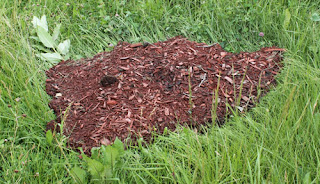
Odd clump of mulch in the field behind the garden

The mystery was solved when I got to the fifth oak. A clump of mulch, presumably glued together with fungal hyphae, floated up in one piece, moved to the field, and settled.
Missing patch of mulch under the fifth oak

I walked back to the creek. Along the way, I saw that our catalpa trees were blooming.
Blooming catalpa

The catalpa flowers have some fancy nectar guides.
Orange and maroon nectar guides

Terry’s nurseries really took it in the shorts. This fence had floated open.
Deer fence opened by the flood

The deer fences caught a lot of flotsam, weighing them down and bending the trees underneath.
Fence pushed over by accumulated flotsam

Broken fence post at the corner
Some of his pots had floated to the nursery edge and tipped over. It looked to me like most of these plants were dead anyway.
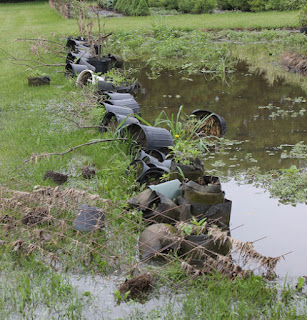
Pots floated away

My woodland garden was not as bad as I feared. The straw floated to the lowest corner, but most of the plants seemed to be in good shape. I’ll have to go back and redistribute it if it ever stops raining.
Straw rearranged on my woodland garden

The plants all around the creek were laid flat. The creek was just barely it its banks.
Matted vegetation by the creek. The flag marks where my ramps were in a cage. The cage was downstream several feet.

More matted vegetation
The deer had been out.
Deer track

The burn pile that Terry had been assembling in the fire ring was long gone. The ring was swept clean with the ashes and gravel deposited just outside the rocks.
Fire ring swept clean in back; ashes and gravel in front

I looked for the wild black currants on my way back to the house. For as many blossoms as I saw, berries were hard to find. Pollen limitation, perhaps? I wonder what normally pollinates these flowers.
Just about the only black currants I could find

The upper garden and raised beds came through fine. One of the beds had an interesting plant growing in it. Hilda thought it was a weed and asked me if we should pull it. I thought it looked like something good. And it was! It has grown into larkspur. How did it get there? No idea. When we first moved here, I planted larkspur behind the tractor shed. But there’s been no sign of that for years. Life is a sacred mystery, John-Boy.
Larkspur growing mysteriously in one of the raised beds

Tuesday night (and every night since), a great blue heron has been stalking frogs in the field. This is the best picture I could get. Just after I snapped the shot, the red-wing black bird seen to the right swooped back to attack the heron’s back, and the heron took off.
Great blue heron hunting frogs while being pestered by a blackbird

Yesterday morning, Terry and I took everything off the floor of the garden shed and put it on saw horses to dry. I hosed off the silt while Terry swept. It seemed ridiculous to put more water on the ground, but it was the best way to clean it up. When it comes to silt, the water giveth; the water taketh away.
We had more rain this morning, but no flooding. We need a few sunny days before we can really assess the damage to the garden. Still could get more rain tomorrow.
And one more random nature observation was this moth I found in the house one morning. It is perfectly camouflaged for a tree. On the bathroom wall, not so much. The thing I found interesting is that it not only has perfect bark-colored wings, but also has a behavior of elevating its abdomen to look exactly like a thorn.
A moth doing a thorn imitation on the bathroom wall


Sunday, June 17, 2018

Father's Day


Today being Father’s Day, I made pecan caramel rolls for breakfast.
Dad with pecan caramel rolls

I got the rolls ready yesterday morning and let them rise slowly in the refrigerator overnight. That gave me the opportunity to pull weeds out of the onions while they were baking. Because the onions were one of the first things we planted, they had the most well-developed weeds. It was a mess. This picture shows a row comparing the unweeded on the left with the weeded on the right.
Weeded (left) vs. unweeded (right) onions

In past years, we have laid down newspaper around the peppers and tomatoes for weed control. This process is a literal pain in the butt. This year, Terry took the initiative to order some cocoa fiber pads that are easy to put down around the stem. He has used them on his trees for years. Why didn’t we think of this before? With the cages in place, the tomatoes will need little care until harvest.
Tomato with cocoa fiber mat and cage

I’ve been logging hours on the mower every week. At first, I was afraid to mow inside the orchard fence for fear of traumatizing the hens. Well. When I finally decided to give it a try, I found that the girls thought that mowing was the best thing ever. Far from being frightened, they ran behind the mower, picking through the piles of cut grass. There must be something good in there!
Out on the lawn I was sure the 13-striped ground squirrels high-fived each other behind my back. Yes! Here comes that lady who cuts the hay for us! Soon they are busily collecting it in their mouths to take back to their dens. They work fast, too. I took 40 pictures before I got this one with its head up.
Ground squirrel making hay while the sun shines

I’ve been trying to get a better picture of the orchard oriole male showing his rusty red body. This one is pretty good.
Orchard oriole, left; female Baltimore oriole, right

This is the female orchard oriole.  She is a striking yellow, not like her Baltimore counterpart at all.
The female orchard oriole has a bright yellow body and dark wings.

We’ve had a red-bellied woodpecker at the feeder. The squirrels have gotten so out of control that I had to stop putting out sunflowers. We have now seen the red-belly, rose-breasted grosbeaks, and red-wing blackbirds all eating grape jelly! Who knew?
Red-bellied woodpecker on the sunflower seed feeder

We have a brown thrasher this year! I had not seen one on our property before.
Brown thrasher

In the cycle of blooming, penstemmon is now taking its turn.
Penstemmon

The potatoes are growing quickly.
Potatoes

The sweet potatoes are also getting big. Hilda is now worried about their vines taking over the garden.
Sweet potato

We continue to struggle to keep the chicks cool enough in the 90°F heat. It is so much easier to keep them warm! We’ve put a larger waterer in the coop. I froze a gallon of water in an old milk jug and put it in the waterer. We also have screens on both doors and a fan blowing. Still, the chicks lounge listlessly by the water.
Meat chickens, considerably larger than the Dominique, hanging by the water cooler
The meat chicken in this picture is doing a “gular flutter” which is like panting. He’s got his beak open and is moving the front of his throat in and out. It is not clear to me why the Whiting True Blue is sitting so close.
Doing the gular flutter
The Dominique chicks are getting black and white wings.
Dominique chicks
A cold front is supposed to move in by Tuesday. We are certainly hoping.

Tuesday, June 12, 2018

Chicks


We had a departure from the usual protocol when the chicks were shipped this year. They went out last week on Monday afternoon. When we did not get a call from the post office Tuesday morning (June 5), we figured they would be in Wednesday morning. I was in the middle of cooking supper at 5:15 when the phone rang. The chicks were in; could we come get them right away? The woman on the phone seemed concerned that the chicks would have to spend the night at the post office.
Hilda said we would be right down. Terry went ahead with his supper while Hilda and I drove to Harvard. We rang the bell, and the mail lady gratefully handed over the cheeping box.
Hilda was just like a little kid on the way home. She kept trying to peek in the box to see the chicks.
“Leave the box closed until we get home,” I said, thinking about how little I wanted to have a chick running loose in my car. “We’ll be there in a few minutes.”
Cheeping box of chicks

We left them in the box until after we ate. We had gotten the coop set up for them the day before, so all we needed to do was tip their beaks into the water to get them to drink. We then set them in their enclosure under the heat lamp one at a time. We got our usual 15 meat chickens. We also got three Dominques, which we have raised before, and three Whiting True Blue, which is new to us. The latter is named for the breeder (Whiting) and the color of the egg, not the chicken. Two of the True Blues are brown and one is either white or light tan. We'll see if she gets darker as she grows.
While Hilda mixed vitamins into the water, I took the Gro Gel Plus down to my kitchen to “mix with ½ cup water until water is absorbed.” The Gro Gel Plus is rather shocking. In the powder form, it is a tan powder resembling unflavored gelatin. When you add water, it becomes a vivid blue-green. As instructed, I spread the gel on top of their food. Boy, did they like that! I perhaps went a little overboard as I put all of it on the food tray, and it was enough for 100 chicks. Oh well. The instructions said to remove anything that was not eaten by morning. They didn’t seem any worse for the wear.
Before long, they had settled in and were taking a nap.
Nap time

The chicks seemed so tiny. I guess we just forget how small they are. This is a Whiting True Blue at one day.
Whiting True Blue chick upon delivery

Here it is again at one week, already getting flight feathers.
Whiting True Blue at one week, already getting grown-up feathers

Compare to the meat chickens at one week. We have started taking the food away at night because they have started growing so fast. We don’t want them going lame.
The meat chickens are already outpacing the layers

Our challenge with having the chicks in the main coop has been keeping the temperatures cool enough. We found one meat chick dead by morning on the first two days. Finally we took the leap and unplugged the heat lamp, leaving just the heated “mother hen” table for them to crawl under. After that, they were fine. We sometimes turn the lamp on for a short time in the morning if it seems cold.
In addition to the Whiting True Blues, we have three Dominiques. They have suffered from pasty butt, but it doesn’t even phase me anymore. I just take them to the bathroom sink and run warm water over their tiny butts until the poo loosens up. Then I fluff their feathers up with the blow dryer on low. I remember what a crisis I thought this was the first time it happened. Now I know they will outgrow it in about three days. The smallest chick (I call her Madeline after the children’s book) still had a little problem this morning, but I didn’t have to take her inside to get it cleaned off.
Everyone seems to be doing well now. So fun to have babies around.

Sunday, June 3, 2018

Hot days in the garden


As I suspected, we went straight from a late, cold spring to the blistering heat of summer. Last weekend through Tuesday, we endured 90+°F temperatures as we worked frantically to get the garden planted before Wednesday’s rain.
The hens spent their day under the coop. We kept the waterer under the ramp so it would always be in the shade. We changed the water in the afternoon. I felt a little bad about the wastefulness of it. The water that had been sitting in the hose all day was hot enough to shower in; I ran and ran it until it cooled off.
Hens under the coop with the waterer under the ramp

The hummingbirds drank often at the feeder for cooling and calories. I got an action shot, finally.
Hummingbird in flight

The conifers are putting on a lot of growth this year. When the new growth sticks up straight, as on this white pine, Terry refers to the sprouts as “candles.” I don’t know if that’s an official name or not because Terry is fond of making up terms. Still, it is easy to know what he means. On the white pine, each little spike will become five soft needles.
New growth on the white pine

Speaking of soft needles, here’s one of my favorites. This is a dawn redwood. It is a deciduous conifer, like larches and tamaracks. The needles fall every autumn and grow back as soft as can be each spring. They never get as prickly as those nasty spruces.The dawn redwood was once thought to be extinct until small populations were discovered in China, where it is endangered from deforestation (a familiar theme). It has been planted all over the place since its rediscovery, and is a nice, fast-growing ornamental.
The lovely soft needles of the dawn redwood

“Grab a spruce, you’ll soon let loose.” Here is the new growth on a green version of a Colorado blue spruce. Terry says people like the green blue spruces better than the blue ones. Go figure. The new growth is a lighter green than growth from previous years. The needles will quickly toughen up. Spruces are not my favorites. I feel the same way about cacti and thistles. Unfriendly plants.
New growth on the blue spruce

Hilda’s sweet potatoes survived and are looking pretty good.
Sweet potato looking perky

Terry was itching to get the corn planted. The thing is that he doesn’t use a string, and the rows end up crooked as a dog’s hind leg. Then I have to try to get the drip lines on them and the landscape cloth around them. The first year he planted the rows two feet apart. I set up the drip line accordingly. The next year, he decided (without consulting me) to plant the rows three feet apart. Clearly, this was just to make my life a living hell, even though he claimed it was “because we have plenty of room.” I changed the drip lines. Last year, I tried to solve it by putting the drip lines down so he could follow them. And when I put down the landscape cloth, which is 3’ wide, I had to fold over one edge six inches to make room for the corn. So this year, I figured I’d put down the landscape cloth and the drip line first so Terry could plant the corn in between. I started folding over the landscape cloth as before, but after the first two rows, I decided that, screw it, I would put the landscape cloth down flat and move the drip lines one last time. I measured the distance between the lines at 3’6”. As God is my witness, I will never move these drip lines again!
I am never moving the corn drip lines again! I mean it this time!

We worked far too long in the heat. The only saving grace was that the humidity went down Tuesday afternoon so I wasn’t dripping sweat as I planted the last bean seeds. The rain came as predicted Wednesday, and afterwards the temperatures finally got back to the normal range of 70’s. This is the perfect weather for gardening, finally. I’ve been planting the raised beds and starting to pull weeds. That’s the way it is—as soon as you get the plants you want in the ground, you have to start pulling out the plants you don’t want.