Sunday, June 17, 2018

Father's Day


Today being Father’s Day, I made pecan caramel rolls for breakfast.
Dad with pecan caramel rolls

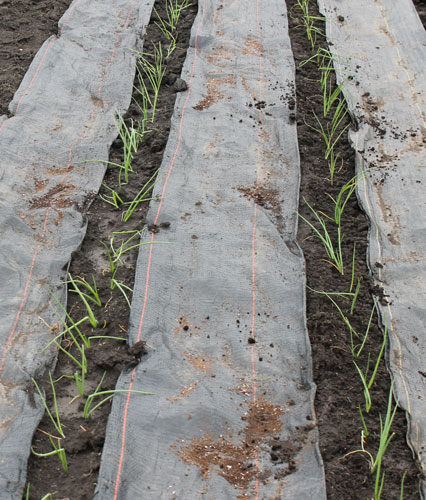
I got the rolls ready yesterday morning and let them rise slowly in the refrigerator overnight. That gave me the opportunity to pull weeds out of the onions while they were baking. Because the onions were one of the first things we planted, they had the most well-developed weeds. It was a mess. This picture shows a row comparing the unweeded on the left with the weeded on the right.
Weeded (left) vs. unweeded (right) onions

In past years, we have laid down newspaper around the peppers and tomatoes for weed control. This process is a literal pain in the butt. This year, Terry took the initiative to order some cocoa fiber pads that are easy to put down around the stem. He has used them on his trees for years. Why didn’t we think of this before? With the cages in place, the tomatoes will need little care until harvest.
Tomato with cocoa fiber mat and cage

I’ve been logging hours on the mower every week. At first, I was afraid to mow inside the orchard fence for fear of traumatizing the hens. Well. When I finally decided to give it a try, I found that the girls thought that mowing was the best thing ever. Far from being frightened, they ran behind the mower, picking through the piles of cut grass. There must be something good in there!
Out on the lawn I was sure the 13-striped ground squirrels high-fived each other behind my back. Yes! Here comes that lady who cuts the hay for us! Soon they are busily collecting it in their mouths to take back to their dens. They work fast, too. I took 40 pictures before I got this one with its head up.
Ground squirrel making hay while the sun shines

I’ve been trying to get a better picture of the orchard oriole male showing his rusty red body. This one is pretty good.
Orchard oriole, left; female Baltimore oriole, right

This is the female orchard oriole.  She is a striking yellow, not like her Baltimore counterpart at all.
The female orchard oriole has a bright yellow body and dark wings.

We’ve had a red-bellied woodpecker at the feeder. The squirrels have gotten so out of control that I had to stop putting out sunflowers. We have now seen the red-belly, rose-breasted grosbeaks, and red-wing blackbirds all eating grape jelly! Who knew?
Red-bellied woodpecker on the sunflower seed feeder

We have a brown thrasher this year! I had not seen one on our property before.
Brown thrasher

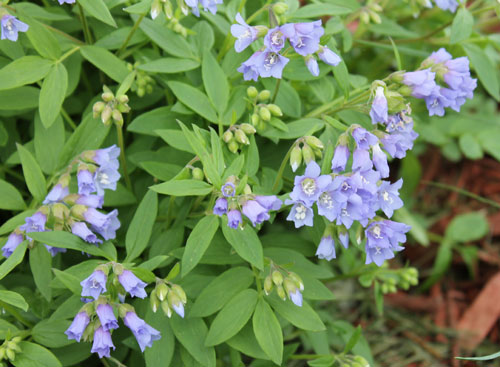
In the cycle of blooming, penstemmon is now taking its turn.
Penstemmon

The potatoes are growing quickly.
Potatoes

The sweet potatoes are also getting big. Hilda is now worried about their vines taking over the garden.
Sweet potato

We continue to struggle to keep the chicks cool enough in the 90°F heat. It is so much easier to keep them warm! We’ve put a larger waterer in the coop. I froze a gallon of water in an old milk jug and put it in the waterer. We also have screens on both doors and a fan blowing. Still, the chicks lounge listlessly by the water.
Meat chickens, considerably larger than the Dominique, hanging by the water cooler
The meat chicken in this picture is doing a “gular flutter” which is like panting. He’s got his beak open and is moving the front of his throat in and out. It is not clear to me why the Whiting True Blue is sitting so close.
Doing the gular flutter
The Dominique chicks are getting black and white wings.
Dominique chicks
A cold front is supposed to move in by Tuesday. We are certainly hoping.

Tuesday, June 12, 2018

Chicks


We had a departure from the usual protocol when the chicks were shipped this year. They went out last week on Monday afternoon. When we did not get a call from the post office Tuesday morning (June 5), we figured they would be in Wednesday morning. I was in the middle of cooking supper at 5:15 when the phone rang. The chicks were in; could we come get them right away? The woman on the phone seemed concerned that the chicks would have to spend the night at the post office.
Hilda said we would be right down. Terry went ahead with his supper while Hilda and I drove to Harvard. We rang the bell, and the mail lady gratefully handed over the cheeping box.
Hilda was just like a little kid on the way home. She kept trying to peek in the box to see the chicks.
“Leave the box closed until we get home,” I said, thinking about how little I wanted to have a chick running loose in my car. “We’ll be there in a few minutes.”
Cheeping box of chicks

We left them in the box until after we ate. We had gotten the coop set up for them the day before, so all we needed to do was tip their beaks into the water to get them to drink. We then set them in their enclosure under the heat lamp one at a time. We got our usual 15 meat chickens. We also got three Dominques, which we have raised before, and three Whiting True Blue, which is new to us. The latter is named for the breeder (Whiting) and the color of the egg, not the chicken. Two of the True Blues are brown and one is either white or light tan. We'll see if she gets darker as she grows.
While Hilda mixed vitamins into the water, I took the Gro Gel Plus down to my kitchen to “mix with ½ cup water until water is absorbed.” The Gro Gel Plus is rather shocking. In the powder form, it is a tan powder resembling unflavored gelatin. When you add water, it becomes a vivid blue-green. As instructed, I spread the gel on top of their food. Boy, did they like that! I perhaps went a little overboard as I put all of it on the food tray, and it was enough for 100 chicks. Oh well. The instructions said to remove anything that was not eaten by morning. They didn’t seem any worse for the wear.
Before long, they had settled in and were taking a nap.
Nap time

The chicks seemed so tiny. I guess we just forget how small they are. This is a Whiting True Blue at one day.
Whiting True Blue chick upon delivery

Here it is again at one week, already getting flight feathers.
Whiting True Blue at one week, already getting grown-up feathers

Compare to the meat chickens at one week. We have started taking the food away at night because they have started growing so fast. We don’t want them going lame.
The meat chickens are already outpacing the layers

Our challenge with having the chicks in the main coop has been keeping the temperatures cool enough. We found one meat chick dead by morning on the first two days. Finally we took the leap and unplugged the heat lamp, leaving just the heated “mother hen” table for them to crawl under. After that, they were fine. We sometimes turn the lamp on for a short time in the morning if it seems cold.
In addition to the Whiting True Blues, we have three Dominiques. They have suffered from pasty butt, but it doesn’t even phase me anymore. I just take them to the bathroom sink and run warm water over their tiny butts until the poo loosens up. Then I fluff their feathers up with the blow dryer on low. I remember what a crisis I thought this was the first time it happened. Now I know they will outgrow it in about three days. The smallest chick (I call her Madeline after the children’s book) still had a little problem this morning, but I didn’t have to take her inside to get it cleaned off.
Everyone seems to be doing well now. So fun to have babies around.

Sunday, June 3, 2018

Hot days in the garden


As I suspected, we went straight from a late, cold spring to the blistering heat of summer. Last weekend through Tuesday, we endured 90+°F temperatures as we worked frantically to get the garden planted before Wednesday’s rain.
The hens spent their day under the coop. We kept the waterer under the ramp so it would always be in the shade. We changed the water in the afternoon. I felt a little bad about the wastefulness of it. The water that had been sitting in the hose all day was hot enough to shower in; I ran and ran it until it cooled off.
Hens under the coop with the waterer under the ramp

The hummingbirds drank often at the feeder for cooling and calories. I got an action shot, finally.
Hummingbird in flight

The conifers are putting on a lot of growth this year. When the new growth sticks up straight, as on this white pine, Terry refers to the sprouts as “candles.” I don’t know if that’s an official name or not because Terry is fond of making up terms. Still, it is easy to know what he means. On the white pine, each little spike will become five soft needles.
New growth on the white pine

Speaking of soft needles, here’s one of my favorites. This is a dawn redwood. It is a deciduous conifer, like larches and tamaracks. The needles fall every autumn and grow back as soft as can be each spring. They never get as prickly as those nasty spruces.The dawn redwood was once thought to be extinct until small populations were discovered in China, where it is endangered from deforestation (a familiar theme). It has been planted all over the place since its rediscovery, and is a nice, fast-growing ornamental.
The lovely soft needles of the dawn redwood

“Grab a spruce, you’ll soon let loose.” Here is the new growth on a green version of a Colorado blue spruce. Terry says people like the green blue spruces better than the blue ones. Go figure. The new growth is a lighter green than growth from previous years. The needles will quickly toughen up. Spruces are not my favorites. I feel the same way about cacti and thistles. Unfriendly plants.
New growth on the blue spruce

Hilda’s sweet potatoes survived and are looking pretty good.
Sweet potato looking perky

Terry was itching to get the corn planted. The thing is that he doesn’t use a string, and the rows end up crooked as a dog’s hind leg. Then I have to try to get the drip lines on them and the landscape cloth around them. The first year he planted the rows two feet apart. I set up the drip line accordingly. The next year, he decided (without consulting me) to plant the rows three feet apart. Clearly, this was just to make my life a living hell, even though he claimed it was “because we have plenty of room.” I changed the drip lines. Last year, I tried to solve it by putting the drip lines down so he could follow them. And when I put down the landscape cloth, which is 3’ wide, I had to fold over one edge six inches to make room for the corn. So this year, I figured I’d put down the landscape cloth and the drip line first so Terry could plant the corn in between. I started folding over the landscape cloth as before, but after the first two rows, I decided that, screw it, I would put the landscape cloth down flat and move the drip lines one last time. I measured the distance between the lines at 3’6”. As God is my witness, I will never move these drip lines again!
I am never moving the corn drip lines again! I mean it this time!

We worked far too long in the heat. The only saving grace was that the humidity went down Tuesday afternoon so I wasn’t dripping sweat as I planted the last bean seeds. The rain came as predicted Wednesday, and afterwards the temperatures finally got back to the normal range of 70’s. This is the perfect weather for gardening, finally. I’ve been planting the raised beds and starting to pull weeds. That’s the way it is—as soon as you get the plants you want in the ground, you have to start pulling out the plants you don’t want.

Sunday, May 27, 2018

The thrill of discovery


I have seen this shrub around for years. 
It reminded me of gooseberry, but it was not thorny, and I never saw it with berries of any sort, goose or otherwise. I finally caught it blooming, which is the best time to try to identify it. I took a picture and hoped fervently that it would be in the wildflower picture book. I hoped against reason, since the shrubs that make it into the wildflower picture book are few and far between. Nevertheless, I prayed to no one in particular, “Oh please, please, don’t make me key it out in Swink and Wilhelm.”
I have a love/hate relationship with taxonomic keys. I first encountered a taxonomic key in Plants of the Pacific Northwest when I took Plant Evolution in college, where I chose as my project keying out X number of plant species. It was hard, but one of my better decisions as an undergraduate. You don’t get very far before you encounter hard words like “glabrous” and “pubescent.” And you have to go to the glossary (for “smooth” and “hairy,” respectively). I learned a lot of plant families, and it got faster as I learned the vocabulary. Still, it is daunting.
The picture book let me down. Nothing in the yellow flowers that remotely resembled it. I had to get out Swink and Wilhelm, Plants of the Chicago Region. And sure enough, I was only to the second page before it wanted to know if the leaves had stipules. The trouble with getting old is that there are many, many times when you know that you once knew something that you cannot remember any more. Thus it was with stipules, although I had a vague mental picture of structures around where the petiole attached to the stem (the actual definition: “an appendage or bract situated at either side of a leaf axil”). The trouble was that I couldn't tell from the picture.
At the time it was not only raining, but dark. A few days later, I had time to walk out and collect a specimen. No stipules. I pressed on. The tubular structure of the flower made me think it might be a heath (Ericaceae), but I ended up with “Ribes in Saxifragaceae.” The leaves seemed saxifrage-like. How do I know this stuff? As it turned out, gooseberries are in Saxifragaceae, so good for me for getting that close by the seat of my pants.
One might think that nothing is drier reading than a dichotomous key. There are, however, almost always moments of discovery that validate that you are on the right track and send a thrill down your spine, things that you would never have noticed if not directed to look for them. In this case it was “Leaves yellow-dotted beneath with resinous glands (use a hand lens).”
I turned the leaf over. “I’ll be damned,” I said out loud. There were yellow dots! My hand lens was not where I thought I left it, so I borrowed Terry’s. There they were, glistening yellow drops on the underside of the leaf. It was Ribes americanum Mill., wild black currant. Even Swink and Wilhelm, whom I think of as stodgy taxonomy types, waxed poetic in a way I’d never seen anywhere else in their book: “The student is encouraged to view, particularly on the lower leaf surfaces, the gorgeous, golden globular, glistening, glittering glands.”
Here they are.
Zoom in if you have to--there are glistening yellow dots on the underside of this leaf.

The berries are edible. I’ll have to see if I can pay attention long enough to beat the birds to them.

Sunday, May 20, 2018

In the garden at last


My last post was written in a hospital waiting room while Jane was having her knee replaced. She went home the following day. I still had to finish out the week at work wrapping up finals and posting grades (and answering emails—no, you can’t have extra credit after the semester is over), so Jane’s friend Jan stayed with her. Plan A was to have Jane’s brother and his wife stay with her a few weeks after surgery. But Dave fell and broke his arm. Plan B was for me to stay with her for a week until she could get in and out of bed and get dressed by herself. Thus, I didn’t do a blog post last week because we were mostly napping—Jane because of the pain medicine and I because I was exhausted from end of the semester.
Meanwhile, May was slipping by with nothing done in the garden. Mostly we were late because of the weather. Terry didn’t even rototill until after he got back from North Dakota at the end of April. It seemed like the ground would never thaw!
Because of the cold weather, the woodland garden of native plants that I ordered during about of cabin fever in February was not shipped until May 7. As you may recall, I prepared the spot for it at the end of March. It arrived the day of Jane’s surgery. I rushed home the next afternoon to get the plants in the ground. One of the plants I most wanted was Virginia bluebells. It was already blooming when the flat arrived. I hoped for the best and planted it along with the others.
I came home briefly Tuesday morning and put stakes into the first 58’ feet of the garden, four rows four feet apart for the tomatoes and the rest in two-foot rows. I picked the asparagus, swapped my long-sleeved shirts for short-sleeved ones, and had to leave for an afternoon appointment.
Friday morning, following yet another appointment (I’d set up quite a few wellness care appointments before I knew that I would be caregiving), I was home for good. We often plant most of the garden at or after Memorial Day. It was the onions and potatoes that should have been in by Mother’s Day. We got all the landscape cloth down for the onions before lunch. I didn’t measure the rows correctly to account for an extra wide row of landscape cloth next to the tomatoes, so the posts didn’t line up like they were supposed to. Hilda had the idea to leave a wider open row for the peas, which put us back on track. With Hilda and I working together, each piece took only 5 minutes.
Meanwhile, Terry got the upper garden ready for a potato experiment. Because we lost all the potatoes in a flood last year, we decided to till up the north garden again. That plot is on a hill and has soil that is not as rich but is better drained. The experiment was the furrower. Instead of digging individual holes as Terry has done in the past, he used a furrower to make a long ditch. Hilda cut the seed potatoes; I put them in the furrow, and Terry raked the soil over the top and put down a marker. It was fast and easy!
Seed potatoes snug in the ground with markers on the top
We had some extra furrows. Hilda bought a pot of sweet potato sprouts at a nursery. It was another experiment. She had talked to two people at the store. One said she had no idea how to plant sweet potatoes. The other said to divide them. So Hilda divided them and put them in one of the furrows. And they looked like hell. They had severe transplant shock, lying on the ground like wet green toilet paper. I watered them thoroughly at the end of the day, and they looked somewhat perkier and turgid then next day.
Sweet potato plants looking somewhat recovered
Hilda and I went to the south garden to plant the onions. I did a row of Cortland, and she did a row of Paterson (a new variety for us).  That was all we had in us for Friday.
Onions
We had a barely measurable amount of rain overnight. We were hoping for more. Still, it wasn’t so muddy that we couldn’t get in the garden, but we did wait a bit to let things dry. I took the opportunity to walk to the creek to check on my woodland garden. The Virginia bluebells were done blooming and lay flat on the ground. I can only hope that they somehow have enough stored in their roots to have another try next spring. If not, I can always order more. Everything else looked pretty good. The strawberries were blooming.
Wild strawberry in my woodland garden
As was the wild geranium.
A rather bedraggled geranium
The may apple leaves were bigger than last year, but no more numerous (still just two). Two of my three trout lilies got eaten by something, even though they are supposed to be deer resistant. Sometimes the deer don’t read the catalog. I was pleased to see the maidenhair fern again.
Maidenhair fern
The jack-in-the-pulpit was huge this year. But like the may apple, there are still only two.
Jackin-the-pulpit
By the fifth oak, the shooting stars, Jacob’s ladder, and phlox are blooming.
Shooting star
Jacob's ladder
Phlox
Up by the house, the trillium are in flower. I got these plants from Camp Pokonokah Hills before it closed, and I will be heartbroken if I lose them. Furthermore, there are three new plants next to these, so they are spreading!
Trillium
I looked under the abundant ginger foliage to find the hidden flowers.
The flower of wild ginger growing low to the ground 
There was one tragedy. The yellow pimpernel that Hilda won in a drawing was eaten to the nubs. Our leading suspects are the ground squirrels, although we also have a lot of rabbits. The nubs are still upright. I wonder if they will sprout again.
Pimpernel nubs
Out by the asparagus, Terry’s lilacs are beautiful and fragrant. I love the smell of lilacs.
When we first moved here, I transplanted some wild iris to a bare spot temporarily. I thought I moved most of them to various wetter places where I thought they’d be happier, but all attempts failed. I obviously didn’t move them all because here was the sight that greeted me in their original location.
Wild iris spreading like crazy
Hilda got down to the garden first and planted half a row of Walla Walla onions. I finished the row with Red Bull. I’d had an inspiration that we could use one of the empty furrows in the north garden for the leeks. Having a furrow in the regular garden is a big pain. (A note on leek culture: the tiny leek plants are planted in a ditch 6 to 8” deep. As they grow, the ditch gets filled in so that the leek will grow with a long white part under the green leafy part.) I went up to plant leeks while Hilda planted shallots. After lunch, we put down one more piece of landscape cloth for a second row of shallots. We had TONS of onion plants this year. I suggested leaving the leftovers in the trays to eat as green onions. The Red Bull plants were already almost market size.
While Hilda finished the second row of shallots, I planted pea seeds. I broke up the crust with a cultivator that has a bunch of spikey wheels that create three parallel row about half an inch deep, perfect for peas. We’ve found that planting peas in three rows with a trellis/fence around the outside gives good yields.
I think I love planting seeds the best, especially big seeds like peas and beans. The tiny seeds are a pain, made worse by bifocals. Planting plants requires a great deal of care and attention so that roots and shoots are transferred intact. As careful as I was to get the onions planted straight and unbroken, when I looked down the row, they were tilted at all angles with bent leaves all over the place. Sigh. Experience suggests, however, that they will pull through just fine.
But seeds just need to get into the ground. I lined them up, staggered across the three rows, pushed each one down a little with my finger and gently swept the soil over the top with my hand. I felt like I was tucking them into bed, even though my goal was to get them to break dormancy and grow. Wake up, little peas! We eagerly await your pods!
When I was done with that, my back had had all it could take. I went into town to get some posts for the fence that would support the peas and protect them from rabbits. Before I left, I had the thought that I would put the posts in when I got back. When I got back it seemed like a better idea to sit down for a spell before making supper.
Terry and I were both excited to hear rain in the night. At day break, however, Terry discovered it had been barely a tenth of an inch. The radar showed more coming about 8:30, and that was the rain we were waiting for. It didn’t slow the birds down one bit. In fact, they may have been at the feeder more because the temperature was in the mid- to upper 40s most of the day. They needed food to keep warm. Here is a hummingbird in the rain.
Mrs. Hummingbird in the rain
Here are Mr. and Mrs. Oriole and Mr. and Mrs. Grosbeak out for Sunday brunch.
An oriole couple and a grosbeak couple out for Sunday brunch
By the time the rain stopped a couple hours later, we’d gotten 0.9”. The potatoes were watered in. I can wait to lay the drip irrigation. Hilda and I took a day off of gardening to catch up on the inside chores and rest our sore gardening muscles. I took the opportunity to make the cinnamon swirl bread that I’d promised for Mother’s Day before I realized that I would be at Jane’s house. Here is Hilda with the finished product. I wanted to get a picture of her taking a bite, but by the time got my camera from the basement, she was already done eating! She was very pleased with it. She shared with Dad, and he was pleased with it too.
Hilda with her belated Mother's Day cinnamon swirl bread

Tuesday, May 8, 2018

Bird-a-licious!

We didn’t get much rain—only 0.6”—but it was enough to, as Terry says,
“paint the world green.” Everything popped. The trees flowered and leafed out. The grass got long enough to hide the brown stubble left from last fall. I mowed for the first time this season.
The chickens have been so happy in the orchard and so busy running around eating grass, bugs, and worms that they have neglected their laying. Slackers! Most days we only get six eggs. I saw a barred rock up in one of the apple trees. So many fun things to do!
A barred rock hen in an apple tree

The rhubarb seemed to explode overnight. I haven’t picked any yet, but it’s ready.
Rhubarb ready to go

Friday afternoon Terry called to tell me that there was “asparagus two feet high out here!”
The asparagus made a sudden appearance
Not thinking there would be very much, I didn’t take a knife or a basket. I picked and picked and picked until I had more than I could hold in one hand. I made a pocket of my shirt by holding the hem away from my body. I estimated the harvest as about a pound and a half.
An unexpectedly large first harvest stuffed in the front of my shirt
The wild ginger is up.
Wild ginger

And the birds are back. Orioles, white-crowned sparrows, goldfinches in their summer plumage, rose breasted grosbeaks. No hummingbirds yet, but the website that Jane watches compulsively says that the are in Wisconsin, so we should see some soon.
Male Baltimore oriole

Immature male or female--I have to look it up ever year, and I don't have my bird book with me right now
The orchard oriole male is rufus colored rather than bright orange and smaller
Three white-crowned sparrows
Mr. Rose-breasted Grosbeak
Mrs. Grosbeak
Downy woodpecker
The goldfinches are notoriously picky about the sunflower seeds they take, tossing 10 over their little shoulders for every one they eat. It is as if they said to the white-crowned sparrows (ground feeder), “Here you go!”
Mr. Grosbeak and Mr. Goldfinch
And the 13-striped ground squirrels are not far behind. Here is one with his/her cheek pouches stuffed so full of seeds that it looks painful.
How many seeds can it stuff in those cheek pouches before they burst?
After I finished mowing on Sunday, I helped Hilda pot up peppers and eggplant. She had already finished the tomatoes. Terry rototilled yesterday, and it will soon be time to plant onions and potatoes.

And it’s grill time. Sunday night Terry made burgers on the grill along with a foil pack of potatoes and onions and another one of Sunday’s asparagus harvest. 
Sunday dinner--burgers with large foil pack of potatoes and smaller pack of asparagus