Sunday, October 7, 2012

Po-tay-to, po-tah-to

It's time to clean out the gardens and get ready for winter. Hilda did most of the work cleaning up the tomatoes. I helped her finish on Friday afternoon. Saturday we worked on the north garden. We got all the drip irrigation lines rolled up for storage. I cleaned out the peppers, beans, cantaloupe, and zucchini. I had big plans for continuing the work today, but after rolling up the landscape cloth from the potatoes yesterday, my back told me I’d better wait a bit before doing any more of that.
We did get two major chores done today. The rest of the potatoes are dug and the garlic is planted. We've been harvesting potatoes since July, and made a good dent in them while they were at their best. My experiment with planting whole sprouted potatoes from last year was a failure. The seed potato apparently rotted, and the rot spread to this year's tubers. Living and learning.
Here are some pictures from the potato harvest.
The potato harvest. Top row, left to right: Red Pontiac, Superior, Kennebec. Bottom row, L to R: Viking Red, Gold Rush Russet. For scale, my feet are off to the right, and the Kennebec are in a paper box.
Tiny and damaged potatoes for immediate use.
There are always some that get cut by the shovel.
The "dog head" potato
The "rubber ducky" potato. Or is it a chicken?
This is probably more potatoes than we can eat before they get all sprouty and wrinkly. As Terry often reminds me, potatoes are commercially available. I get into a mindset, though, where it doesn't occur to me that I can buy produce. Last winter, for example, it struck me as a new thought that I could buy lettuce. Imagine! A salad in February! I just get caught up seasonality. Not only do I not think about buying produce out of season, I get irritated when I see recipes for, say, asparagus and cherry tomatoes. Come on! Those two are NEVER available at the same time.
We have had as many as 4 eggs a day, still mostly brown. The Aracaunas are taking their sweet time at maturing. We have one green egg about every other day. When I get impatient, however, I remind myself that we will likely have more eggs than we can handle in the blink of an eye. We had the smallest egg yet a few days ago—0.8 oz. It was so cute!
Left to right: Grocery store large, teensy-weensy egg (0.8 oz), our usual pullet egg.
Hilda thought that I should have the teensy-weensy egg. She wondered if it was yolkless. When she was growing up, their young chickens sometimes laid eggs with no yolks. The egg had a yolk, but no yolk membrane! How odd.
Clockwise from top: Pullet egg, teensy-weensy egg with no yolk membrane, anemic grocery store large egg. The downside of blogging is that I overcook my eggs.

Sauerkraut Sunday

September 30 was Sauerkraut Sunday. In preparation, Hilda watered the cabbage on Saturday. We are still woefully dry. The cabbage needs to be well-hydrated so it will give up enough fluid to cover the leaves during fermentation. The first time we made sauerkraut way back when, I did not understand that it was an anaerobic process. The sauerkraut was not completely covered with brine, and it rotted.
Pat and Nancy came over to help. Hilda put all the leaves in the dining table so we could set up an assembly line.
 
Production line
Hilda trimmed off the outer leaves and washed the cabbages at the sink. She piled them up for Pat, who cut them in quarters.  Hilda also took the pictures, which is why we don’t have one of her.
Pat cuts the cabbages in half
I put on my wire mesh glove and sliced the cabbage on the sauerkraut cutter. It’s like a mandolin with three blades and high wooden sides. It came with a tongue-and-groove safety box, but it is cumbersome to try to keep ones fingers behind the box while keeping the cabbage correctly oriented over the blades. The glove is way better. Pat can’t do the slicer. Despite showing gruesome training videos for the Red Cross for 19 years, the risk of seeing actual blood gives her the willies.
I slice the cabbage with my hand protected by a glove woven from plastic-covered wires
Nancy weighed the cabbage one pound at a time, which is all that would fit on the scale. When she got 5 pounds in a giant bowl, she added the salt and mixed it. The salted cabbage was packed into a crock.
Nancy mixes the cabbage and salt....

...and packs it into a crock.
We put 20 pounds of salted cabbage in our big crock. Pat and Nancy put 5 pounds in one crock and 2.5 pounds in another to take home. We weighted the top with zip-top bags filled with water.  In a short time, the salt pulled water from the cabbage (a process we call osmosis in the business), and it looked as if there would be plenty of brine. The bubbles that signaled successful fermentation were evident before bedtime. Now we wait until the bubbling stops.
After we got the sauerkraut processing all cleaned up, we adjourned to the deck for nachos, salsa, and guacamole. It was nice to be out on the deck, even if a bit cool. We hardly used the deck all summer long because of the heat. The chickens wandered around in their run, keeping us company with their gentle chicken noises.

Saturday, September 29, 2012

First Easter Egg


Our first Araucana egg, sort of blue-green, in front of today's Dominique egg and next to grocery store large eggs.
Hilda noticed Bridget sitting in a nest box for a long time today. Finally, Hilda reached underneath her, and there it was—our first blue egg from an Araucana. I was away at a workshop at the time and did not get the news until I got home. Very exciting! We have five Araucana, so once they all start laying, production should more than double.
Up until now, we believe that all of our eggs were coming from the Dominiques. We have three of them. For about a week, we got one a day. Recently, that has gone to two. The size is creeping up into the “small” range. Early on, we had one that was 1.8 ounces. One of the chickens had skipped from teensy to large! When we cooked the egg, it had a double yolk. Another large egg a few days later also had a double yolk. I think I remember reading that double yolks are common from young hens. With practice, they get it right. We’ll see.
A double-yolked egg. We've had two so far.

I suspected the Aracauna would start laying soon. Thursday morning when I was cleaning the coop, I noticed that Ingrid did “the squat” when I stroked the back of her head. I first observed this behavior in Sara after she had started laying. When I petted her head, she lifted her shoulders, spread her wings slightly, and bent her legs. I mistook it at first for the poop position, but no poop was forthcoming. When I repeated the touch, she repeated the posture. It was then that I realized I was a big disappointment to her. This was a “come hither” sign for a rooster. Sorry, Sara. Sorry, Ingrid.
Meanwhile, we’ve had several good frosts. The tomatoes are quite dead. I’m working on processing the ones Hilda picked just before the first frost. They have been ripening here and there throughout the house and greenhouse ever since. Tonight I am going to make spaghetti sauce. Tomorrow we will begin fermenting cabbage for sauerkraut.  We will have to dig potatoes soon. Hilda dug up some Gold Rush russets last week. The results were encouraging, as there were some really big spuds in there. Some years we get nothing but tiny ones, which are rather a pain to peel.
Gold Rush russet potatoes. The large one in the upper left is probably 5 inches long.

Saturday, September 15, 2012

EGGS!


Thursday, September 13. When I cleaned the coop in the morning, Sara was sitting in a nesting box on top of the ceramic eggs. She was not inclined to move, either. I lifted her up one side at a time to check, but nothing. Still, I thought it was a good sign.
Sara sitting in the nest box on top of the ceramic egg (white)

Terry and I were watching the Bears getting walloped by Green Bay that evening when I heard footsteps on the stairs. My mother knocked and asked to come in, which is nothing unusual. She often comes down to get things out of or put things in freezers, etc. My dad had come down also, which was unusual.  Hilda was grinning like a little kid at Christmas. “We have an egg!” she announced, holding out a tiny, perfect little brown egg. Well. She and I got on the phone to call all the people who have been following the chicken adventure most closely—Pat and Nancy, Jane, and Kate. This first egg was found on the floor of the coop.
First egg on the floor of the chicken coop (and Ellie has to know what's going on)

No more eggs the next morning. When I got done at the Fitness Center about 2:00 Friday afternoon, there was a message on my office phone (and my cell phone, and my email) that a second egg had been found AND this one was in a nesting box! Hilda had also weighed both eggs. Egg #1 was 1.2 oz. and Egg #2 was 1.1 oz. She compared this to the standard grade sizes—a small egg weighs 1.5 to 1.75 oz. So these were, presumably, teensy eggs. (Jane says they are called “pullet eggs” which makes a certain amount of sense, since pullets are young hens. I can never see that word without thinking of the Anguished English story about the student who wrote about someone receiving the “Pullet Surprise”.)
The second egg in the nest box with a brown ceramic egg (in back)

Our first two teensy eggs

Hilda and I divided the eggs this morning. She gave me the first egg and kept the second. Tragedy struck when I was trying to show Terry that the shell seemed just as hard as a normal egg. Somehow the egg stuck to my fingers as I opened my hand, and instantly the egg was on the floor. The shell was not strong enough to withstand impact with tile-covered cement. I could only think of the immortal words of my late Uncle Carl, who always knew what to say in a crisis: Well, God damn.
The sad fate of the first egg

Let me tell you, there is quite a lot of fluid inside a 1.2 oz. egg. A paper towel and a half was not enough. Terry got a wet rag and finished what I couldn’t wipe up. Hilda graciously surrendered the second egg, since she was having a doughnut for breakfast anyway. I called her in when the egg was ready so she could have a bite. It was delicious!
External comparison between the second egg and standard large eggs

Internal comparision of the second egg (right) and a grocery store large egg (left).
Note lovely golden color and round, upright stance of our egg's yolk.

Terry spotted the third egg this morning in the middle of the run. His hypothesis is that these eggs are so small that the hens don’t really know they’re coming, so they just drop them wherever. According to this hypothesis, they will get better about laying them in the nest boxes when the eggs are larger. We shall see!


The harvest continues


One upside of the drought is that the tomatoes are virtually fungus free this year. Often by late August, the tomatoes are almost completely defoliated and production is slowing down. This year, however, we’ve got tomatoes everywhere! We usually only can the Roma tomatoes, and they have been late for reasons we cannot imagine. Not cold weather, certainly. We’ve had a problem with squash beetles getting on the tomatoes when they are ripe. Hilda has resorted to picking the tomatoes a bit earlier and letting them ripen in her room.
Tomatoes ripening on every flat surface in Hilda's room
Labor Day weekend was busy with putting up. Jane came up on Saturday to make pepper relish, which is tradition in her family. I’ve mentioned before that we are having a bumper crop of peppers. We made two batches of pepper relish, ending up with 10 pints. I grilled the rest of the peppers the next day, took off the skins, and froze them. It always reminds me of cleaning pelts. I peel the skin off the outside, cut the pepper lengthwise, scrape out the seeds, and put the flat, cleaned peppers in a stack. I feel like I should take them to the trading post next.
Sweet pepper harvest. Pepper relish takes half green and half red peppers

Jane grinds the peppers and onions

Peppers, onions, salt, sugar, and vinegar cook before canning

10 pints of pepper relish

I know I said we only had one peach in this year’s crop. I should clarify that we only had one GOOD peach. We also got a fair number of little runt peaches from some trees that have frozen back several times but not died. The peaches were astringent and not freestone, which confirmed Terry’s hypothesis that only the root stock had survived those tough winters. Peach trees come grafted—a hearty root stock on the bottom and a scion that produces a better fruit on the top. Terry only buys trees that have been grafted with freestone scions. On Labor Day, I decided to try pickling these runt peaches. The upside was that peaches are pickled whole. No trying to remove the pits. The downside was that these runts didn’t want to give up their skins even after blanching. And, being small, they were hard to handle and there was a bazillion of them.
Runt peaches with a quarter for size reference

I found a recipe in one of my cookbooks and quickly realized that pickled peaches were invented to use up astringent runt peaches. Eight pounds of “small, firm” peaches and 3 pounds of sugar. Soak the peaches overnight in the syrup with a cheesecloth-wrapped bouquet garni of clove and cinnamon. It seems like if you put rocks through a similar protocol, you would get something good to eat. Hilda had to finish the canning on Tuesday while I was at work. In three to four weeks, we will be able to taste the results.
Peaches steeping in sugar syrup with spices

Hilda continues to make interesting discoveries while she waters. This time it was two black swallowtail caterpillers in the parsley.


Black swallotail caterpillars on the parsley
Last weekend, I had to deal with the hot peppers and the sweet mini bell. I put jalapenos and mariachi pepper in the smoker and froze them. I also put up some hot pepper relish and canned whole jalapenos, whole mini-bells, and sliced jalapenos. After supper, I made a double batch of stuffed peppers to freeze. Sometimes it is a relief to get back to work on Monday.

Hot peppers, before

Hot peppers, after

Friday, August 31, 2012

No eggs, but...


The hens have been poking around in the nesting boxes. The wood chips have been disturbed. The ceramic eggs aren’t where they used to be. And nobody pooped in there, just like the books said. It appears that instinct will carry the day again.

Ellie remains the friendliest of the bunch. Yesterday when I was tidying up the coop, she came in for pets. I picked her up and almost instantly Julia and Sara came in and stood as if waiting their turn. Does Ellie’s cooing call them for attention?
The girls are getting their combs and wattles. I thought it was time to put up another series of portraits so you can see how they have changed. It’s very hard to tell some of them apart. Sara and Giada’s beaks are nearly identical now. I have figured out that Sara’s tail has a black stripe all along its length while Giada’s is broken by bands of white. Ellie, for the moment, still has a beak that is lighter than her sisters’.
Ellie
Ellie's comb and wattle
 
 
Sara


Giada

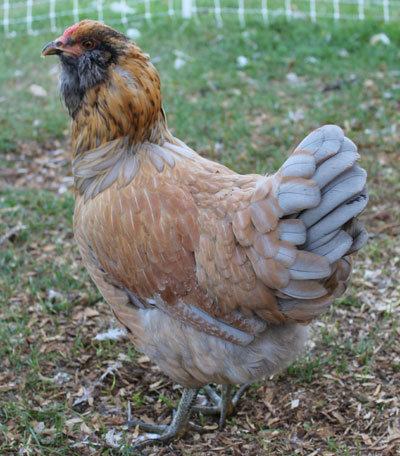
All of the Araucana remain distinctive. Julia gets browner all the time. Nigella has stray gray feathers among the tan. Bridget has kept her pure white color. Ina’s feather patterns seem to become more intricate all the time. Ingrid is developing gray beneath her dark tan feathers.
Ina's beard is getting blacker

Bridget, ever pure white

Ingrid, with her underlayer of gray

Julia (note: Ellie's tail is in the picture because she is pecking at my cuff)

Nigella with stray gray feathers

Jennifer’s comb is darker red and more pronounced that Clarissa’s, but I suppose that could change too. We have discussed leg bands, but I don’t know where to get them. I’m also a bit daunted by the prospect of installing them. I can’t think the girls will like it much.
Clarissa

Jennifer (Ellie is never far away)

On the nature front, Hilda spotted a lovely spider sitting on its orb web in the garden. She found it after she watered, which accounts for the picturesque droplets on the silk.
Spider in the garden

Sunday, August 26, 2012

Rainy Sunday


The chickens passed another milestone last week. They are now 16 weeks old and are eating pelleted “layer feed” instead of chick crumbles. As the names suggest, the adult food bits are bigger than the chick bits. The “layer” here refers not to stratifications (which is what first popped into my mind) but to laying hens. Layer feed has somewhat less protein than chick feed.

I made a video of the chickens going after an ear of too-ripe corn. Hilda and I cleaned out the corn patch on Friday, ate what was salvageable and saved the rest for the girls. They LOVE corn. I imagine chicken dialog as I watch them: “CORN! Corn, corn, corn, corn. MY corn. No, MINE. Give that back!”
The pumpkins are nearly ready for harvest a month early. All the vines are dying back to reveal a pretty good crop.
About half of the pumpkin patch

My little Johnny-jump-ups are blooming bravely despite the drought and heat we’ve had this summer.
Johnny Jump-ups

We are enjoying a glorious and long-awaited rainy day today. I can almost hear the oaks sigh with relief.
The fifth oak rejoicing in the rain

We see the turkeys just about every morning. As they cruise through the tall grass with their heads down and their backs hunched, they look more like a herd of raccoons or anteaters, even. Not bird-like, in any case. They visit all the oaks, eating the numerous acorns that have fallen.  They hunkered down beneath the river birch for awhile this afternoon. It doesn’t seem like much shelter to me, but it seems to work for them just fine. The chickens, snug in their coop, are much drier.
Our turkey flock (usually two hens and 10 chicks)


Hunkered down under the river birch